TikTok Local Feed helps people discover nearby businesses, places and events. For a multi-location brand, the useful starting point is a public account, accurate local content and a clear owner for publishing in each market.
You can keep a recognizable brand voice while making each post useful to its neighborhood. The operational challenge is deciding who films, who approves and which account publishes, then measuring whether that work contributes to local business goals.
This guide compares account structures, sets out a practical approval workflow and explains how to run a local pilot. Platform rules are linked to TikTok’s documentation; location counts, staffing choices and pilot lengths are planning recommendations, not TikTok requirements.
What TikTok Local Feed actually is
TikTok describes Local Feed as a home-screen tab for nearby discovery. Its February 11, 2026 U.S. announcement names location, content topic and posting time as recommendation factors.
Treat it as an additional discovery surface. TikTok has not published a formula that lets a brand guarantee placement or rank one post above another.
Where Local Feed sits in the app
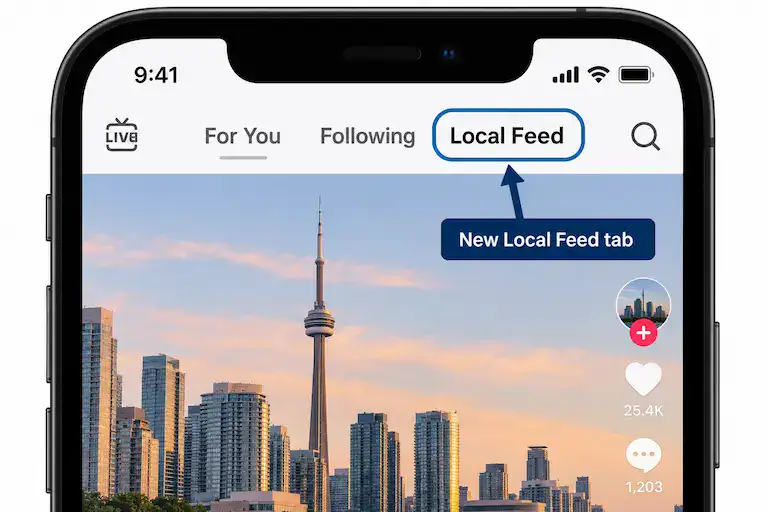
Look for Local or Nearby on the home screen where the feature is available. Naming and placement can vary by market and app version; the accompanying illustration is not an official interface capture.
Nearby discovery still includes personalization. Local relevance adds context to what someone might want to watch; it does not make interests and engagement irrelevant.
Recommendation factors: location, topic, and recency
Location, topic and freshness are the factors TikTok names publicly. They are useful planning inputs, not an exhaustive ranking formula.
TikTok’s Nearby Help Center guidance says relevant posts can appear without a location tag, using device, network or permitted location information. An accurate tag helps explain the place; it is not a guaranteed admission ticket.
Name the location clearly for viewers, check the correct branch before tagging and avoid suggesting that a spoken neighborhood name is a documented eligibility requirement.
Eligibility and regional limits
TikTok lists these account and post restrictions. Its Nearby documentation also includes an age limit for posts:
- Content must come from a public account
- The creator must be 18 or older; Nearby viewers must also be 18+ and logged in
- Nearby excludes posts older than 90 days; check the applicable Local guidance in each market
- Posts set to Friends or Only You are excluded, as are private accounts entirely
Rollout status and reach reality check
TikTok announced U.S. Local Feed on February 11, 2026. The European Nearby launch announcement is dated December 4, 2025.
Use those announcements as rollout milestones. They do not establish that every eligible account in an announced country has identical access today.
Announced markets and access checks
The European announcement named France, Germany, Italy and the UK. Together with the U.S. launch, these are the markets documented by the linked announcements, not a verified exhaustive list of current availability.
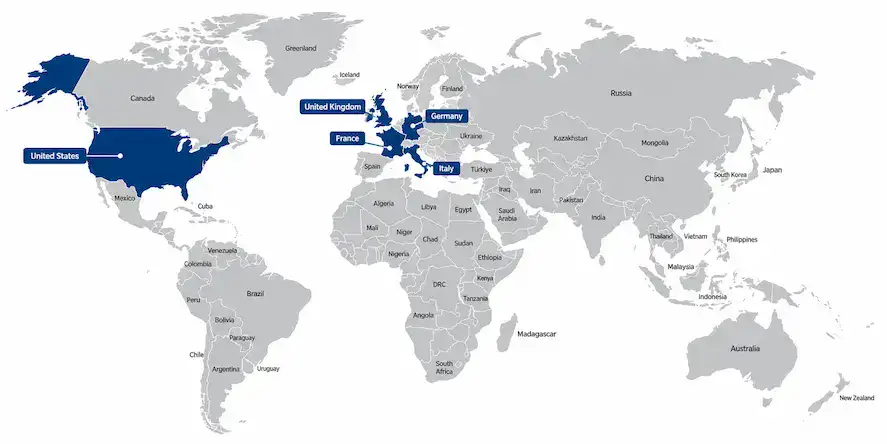
If your markets span both regions, expect naming and interface differences, and confirm availability market by market before you promise stakeholders a synchronized launch.
Plan for local relevance, not a fixed reach ratio
Build forecasts from your own market and account data.
A local surface addresses a different audience opportunity from broad discovery. Age restrictions, availability and audience behavior affect reach, but TikTok has not supplied a universal Local-to-For You reach ratio.
Do not calculate an audience ceiling by multiplying an assumed GPS opt-in rate by an assumed age-qualified audience.
Forecast local actions and production capacity first, then revise expectations with pilot data. Keep total video views separate from any reach explicitly attributed to a feed.
Privacy, opt-in mechanics, and what brands need to know
Separate permission to collect precise GPS data from other location signals. The U.S. launch announcement calls precise location optional and off by default; Nearby documentation describes approximate location from device and network information. Do not turn that into a worldwide claim that GPS permission is mandatory to see local content.
How users turn it on and off
Where available, users can review location access in TikTok under Profile, Menu, Settings and privacy, Privacy, then Location Services. Device settings also control permission. Menus and options depend on the region, device and app version.
Precise location sharing is off by default in the U.S. announcement and, when enabled, is used while the app is in use. An app permission prompt does not establish a separate, universal two-step feed opt-in process.
Privacy-by-design implications for brand accounts
For brand teams, the practical action is accurate place information, not asking audiences to disclose their location. Use the right branch name, a relevant location tag where available and truthful details about the event or offer.
Get permission before featuring identifiable customers or staff, and keep private addresses, staff schedules and customer information out of footage. Local contributors should know what to escalate before filming.
The tension: national brand consistency vs. local content authenticity
Multi-location brands built their equity on sameness. A customer in Denver and a customer in Tampa should recognize the same brand instantly.
A Tampa street-fair video may be more useful to nearby viewers than a generic national spot. That is a creative hypothesis to test, not a guarantee that it will outrank the national creative.
Why the systems conflict
That pulls two goals apart. Your brand system exists to prevent drift, yet local relevance requires the kind of specificity a central team cannot manufacture at scale.
Local creators and store managers hold the raw material, but handing them the keys risks the consistency you protected for a decade.
What actually resolves it
The resolution is not a better template or a looser one. It is deciding who owns which decision, and encoding that in how your accounts and workflows are structured.
If you have not documented who owns the brand call yet, our guide to setting brand voice guidelines gives you a starting point for that conversation.
How Local Feed compares to For You, Following, and Search
These four discovery surfaces serve different needs. For You is personalized discovery; Following centers on accounts someone follows; Search responds to a query; Local or Nearby emphasizes place.
TikTok’s recommendation guidance describes personalized Following feeds. Search also considers relevance and other signals, so neither surface is accurately reduced to chronology or keywords alone.
The location and permission columns below distinguish the purpose of the content from optional precise-GPS access. Check the market-specific interface before planning a launch.
The table below maps the differences across the dimensions that affect strategy: ranking signal, location requirement, opt-in, eligibility, and typical content. Use it to decide where a given asset belongs before you produce it.
Before planning for Local Feed, establish a public brand presence, a sustainable content plan and a clear audience. Local discovery adds to that foundation.
| Surface | Main recommendation context | Local context required | Precise GPS mandatory? | Eligibility restrictions | Typical content type |
|---|---|---|---|---|---|
| TikTok Local Feed | Location, topic and freshness | Yes | Not a universal rule; optional precise location | Public account, 18+ | Short video, creator replies, series formats – tied to local places/events |
| For You | Interests + engagement + other signals | No | No | Public account | Any format matched to viewer interest |
| Following | Followed accounts + personalized ranking | No | No | Public account or approved follower | Any format from accounts the viewer chose |
| Search | Query relevance + personalization | No | No | Public account | Any indexed public content matching the query |
Location, topic and freshness
Yes
Not a universal rule; optional precise location
Public account, 18+
Short video, creator replies, series formats – tied to local places/events
Interests + engagement + other signals
No
No
Public account
Any format matched to viewer interest
Followed accounts + personalized ranking
No
No
Public account or approved follower
Any format from accounts the viewer chose
Query relevance + personalization
No
No
Public account
Any indexed public content matching the query
Account architecture for multi-location brands: one account or many?
Every downstream choice (governance, measurement, staffing) traces back to account structure.
There are three viable models: central, hub-and-spoke, and distributed, and the right one depends on your location count, team capacity, and how much governance you can realistically enforce.
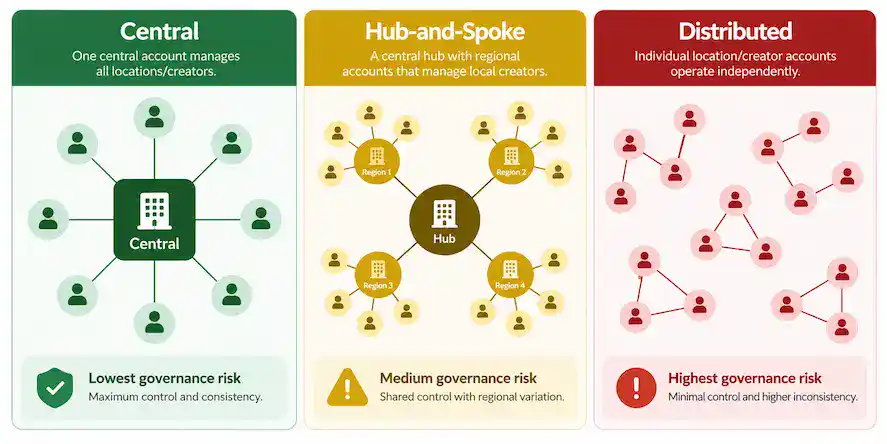
Central account with location-tagged posts
A single public brand account can publish content for multiple markets. TikTok does not list a separate account per branch as an eligibility requirement. Use accurate local posts and check placement rather than assuming that a tag guarantees it.
The upside is centralized ownership and consolidated reporting. The limit is production capacity: if one team cannot cover every market well, local coverage thins out. A central account can still use footage from trained local contributors.
Hub-and-spoke: regional or store-level accounts under brand governance
Hub-and-spoke gives each region or high-volume location its own brand-owned account. Central owns the brief, brand guidelines, and pre-approval workflow; local teams and local creators post inside those guardrails, tying content to local events and neighborhood detail.
Regional accounts can make editorial ownership clearer, but account count is not a documented ranking advantage. Each account adds moderation, access management and publishing work, so fund that capacity before creating it.
Which structure fits your situation
The three models are central, hub-and-spoke, and distributed. The table below compares them across the factors that actually decide your fit: location count, team capacity, and governance appetite.
Filter by model to compare one at a time. These are editorial planning judgments, not platform eligibility ratings; the quiz below uses simplified location-count and capacity inputs as a starting point.
| Account model | Best for | Local publishing capacity | Brand governance | Team capacity needed | Biggest risk |
|---|---|---|---|---|---|
| Central account (single) | Manageable local production needs or limited account-management capacity | Moderate Limited volume per market | Content feels generic per market | ||
| Hub-and-spoke (regional or store-level accounts) | Regional production needs with funded local owners | Strong Dedicated local editorial ownership | Requires modular brief and pre-approval | Brand drift without enforced governance | |
| Distributed (creator-led, brand-affiliated) | Franchise or partner networks with autonomous operators | Strong Depends on local operators and accurate content | Unless playbook is enforced | High locally | Inconsistent brand presentation across markets |
Manageable local production needs or limited account-management capacity
Moderate
Limited volume per market
High
Low
Content feels generic per market
Regional production needs with funded local owners
Strong
Dedicated local editorial ownership
Medium
Requires modular brief and pre-approval
Medium to high
Brand drift without enforced governance
Franchise or partner networks with autonomous operators
Strong
Depends on local operators and accurate content
Low
Unless playbook is enforced
Low centrally
High locally
Inconsistent brand presentation across markets
Need a TikTok account structure decision made?
Our strategy team builds custom social roadmaps for multi-location brands, covering account architecture, platform sequencing, and KPI frameworks your stakeholders can actually approve.
Content governance without killing local relevance
Guardrails work when contributors know what they may publish and when they must escalate. Decide the approval tier before production so routine local posts can move quickly and sensitive content gets the right review.
The modular brief: what central owns vs. what local fills in
Build a modular brief with locked fields and variable fields. Central owns the hook format, tone guardrails, and required brand elements.
Local teams or a local creator fill the variables: the specific local event, the landmark reference, the store-only offer, the caption line that names the neighborhood. That split keeps the brand recognizable while letting the content sound like it belongs to the place.
Use three approval tiers. Routine store tours and approved recurring formats can use delegated local approval. New prices, offers, partnerships and product claims need the named central reviewer. Complaints, incidents and sensitive claims pause for the appropriate brand or specialist owner. Set the turnaround and backup reviewer in the brief.
A usable brief includes: market and branch, intended viewer question, approved claim, local variable, offer dates, footage permissions, publisher, reviewer, response deadline and tracked next action. Central approves the reusable pattern; local owners verify the facts before each publication.
Rolling a local win to other markets
When a format performs in one market, treat it as a hypothesis, not a one-off.
Document the hook pattern and the variable fields it used, then hand the same brief to three other markets with their own local variables swapped in. This turns a Tampa win into a repeatable test across the network, so no region starts from a blank page.
Enabling store managers and regional teams
Give local contributors a short playbook, a 20-minute training clip, and a template library they can pull from. When the guardrails live in the assets, review becomes the exception rather than the bottleneck.
Assign a backup owner for every account, use business-controlled access and document the handover when an employee or creator leaves. Each location also needs a named person to monitor comments, correct expired offers and escalate complaints.
Content practices for local discovery
Build content around a nearby viewer’s decision: what is available, where it is, when it happens and why it is useful. Accurate metadata supports that clarity; placement remains algorithmic.
Metadata that signals local relevance
Add the correct branch or venue tag when available. State the business, neighborhood and any dates or opening hours naturally in the caption or on screen. Keep text readable and captions accessible rather than repeating place names for the algorithm.
Useful local detail might include an entrance, a nearby transit stop or an event date. Verify it with the local owner and remove or correct time-sensitive offers when they expire.
Hooks and formats that fit local context
Travel, dining, shopping and local events are examples in TikTok’s announcement, not proof of a closed category list. Choose formats that answer real local questions.
Event tie-ins work: a video framed around a festival or game day in that market. So do neighborhood POV series, store tours led by a local creator, and local offers that only make sense to nearby viewers.
Evaluate the post’s usefulness and the team’s ability to sustain it. A separate regional account should follow a staffing decision, not an unsupported promise of better reach.
Measuring Local Feed performance without a dedicated dashboard
Agree on the business outcome before the pilot: reservations, store-locator visits, qualified inquiries or offer redemptions. Then check which analytics fields are actually available in your account.
Separate observed metrics from attribution
Do not assume your analytics include a dedicated Local Feed breakdown. Inspect the current traffic-source options and retain an export or screenshot of what your account actually reports; availability can change.
If Local is not separately identified, report overall post performance and tracked business actions. Do not relabel total views or profile visits as Local Feed reach.
Proxy signal framework for local attribution
Use a log with post date, account, market, format, tagged location, production cost and measured outcome. Compare similar formats and publishing windows; a tagged-versus-untagged difference alone cannot isolate the feed or prove that a tag caused the result.
Where website links are available, use market-specific landing pages with UTM parameters and compare sessions with completed actions in your own analytics. Use distinct offer codes or reservation sources where feasible. These identify tracked TikTok journeys or redemptions, not the exact feed that exposed someone to a video; do not assume profile visits can be segmented by city.
Piloting in a subset of markets before full rollout
Do not launch across every market at once.
As a planning starting point, select three to five markets and an eight-week test window. Record a comparable pre-pilot baseline separately, keep a similar non-pilot market where practical, and log paid activity, promotions and seasonal events that could affect results.
Review results weekly alongside approval turnaround, staff hours, moderation coverage and missed posts. Expand only when local owners can sustain the workflow and the business signals justify the effort. A pilot informs a decision; it does not establish causal lift without a stronger experiment.
This simplified recommendation is a discussion starter, not an eligibility test. Review staffing, ownership and the comparison above before creating accounts.
Which account structure fits your situation?
Answer three questions about location count, team capacity, and governance to see a recommended structure.
Want outside eyes on your Local Feed plan?
Our consulting team audits your current TikTok setup, maps your account model against your location count and governance capacity, and hands your internal team a prioritized action plan with a proxy measurement framework built in.
Frequently Asked Questions
The Bottom Line
Local discovery gives multi-location brands another reason to make content useful to a specific place. Start with accurate local information and eligible public posts, then check the regional experience rather than relying on a universal GPS or reach rule.
Choose an account model the team can staff and govern.
Give central and local teams clear decision rights, pilot the workflow and track business actions with explicit attribution limits. Expand when production, approvals, moderation and results support it.