To create a brand presence on social media, define what you want people to recognize you for, choose channels your audience uses, publish useful content in a consistent voice, and make time for conversation. Measure both recognition and business actions, then adjust the plan.
Start with a quick audit: pull up your last 20 posts. Could a stranger describe who you help, what you stand for, and why they should follow? If the answer is unclear, use the 11 steps below to connect your identity, content, community and measurement.
Stage-Based Priorities: What Matters at Zero, Growth, and Scale
Use these stages to choose your next priority, not to judge success by follower count. The follower ranges are rough planning labels: a niche B2B brand can generate qualified demand with a small audience, while a large account may still need foundational work.
Pre-launch (0-500 followers): Foundation before traffic
Start with identity, platform selection, profile setup and enough useful posts to explain your offer. A 15-20-post backlog is an optional planning buffer, not a launch requirement. Invite relevant people once the profile gives them a clear reason to follow.
Growth stage (500-10,000 followers): Consistency and community signals
Cadence and community management now matter more than polish. Prioritize genuine questions and relevant conversations. Consider a small paid test when you have a clear objective, suitable creative and a measurable destination. Use saves and shares to diagnose content usefulness, then connect the main goal to a business action such as a qualified inquiry or signup.
Scale stage (10,000+ followers): Authority and earned presence
Priorities shift toward earned mentions, creator partnerships, and user-generated content programs. Track brand equity signals: branded search volume, unprompted mentions, and share of voice against competitors.
Step 1: Build the Brand Identity Foundation
Everything downstream traces back to four inputs: mission, values, voice, and visual system. Your content, your captions, and your reply tone all rest on those four.
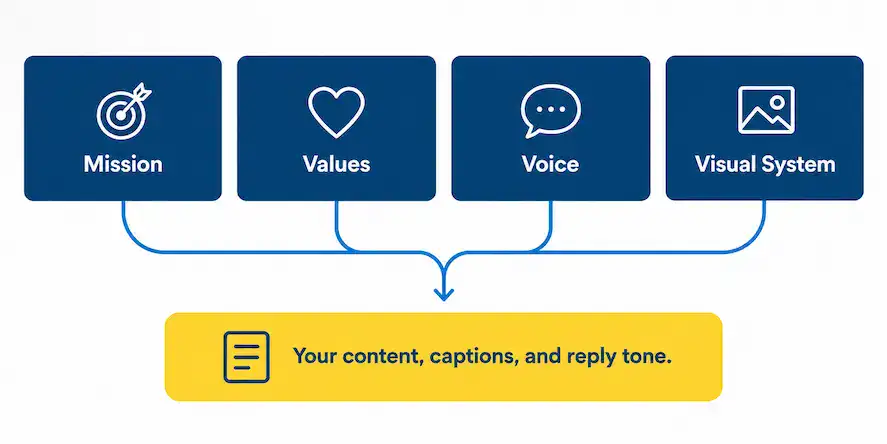
Four inputs, one consistent brand
- Mission
- Values
- Voice
- Visual system
Your content, captions and reply tone
When these four are vague, every person touching the account fills the gap with their own instinct. That is the mechanism behind an inconsistent feed: not laziness, but ambiguity resolved 40 different ways by 40 different posts.
Mission and values as editorial filters
A mission belongs in your workflow, not on a wall. Used correctly, it acts as the yes/no filter on content decisions.
For example, a hypothetical sustainability-focused outdoor brand might reject a trend requiring single-use props because it contradicts a stated value. A promising idea should still pass the brand’s editorial filter.
Values that never cause you to say no to a good-performing idea are decorative, not functional.
Defining brand voice beyond adjectives
“Friendly, professional, witty” is a starting point, but a writer also needs examples and boundaries.
Instead, define your brand voice in behavioral terms: what the brand says, what it refuses to say, and how it responds under pressure.
Write the specific sentence you’d send when a customer is angry or frustrated. List the topics you never joke about. Note whether you use contractions and one-line replies or full paragraphs.
Visual identity rules for social
A social-ready visual system needs specifics: exact hex codes, a defined font pairing, a template grid for carousels and quote cards, image treatment rules (filter, crop ratio, border), and logo clearance space.
Vague guidelines break the moment two people produce content in the same week. “Use our blue” produces five blues. “#0070CD only, never a gradient” produces only one.
Step 2: Set Goals Tied to Funnel Stage and Business Outcomes
Follower growth can indicate reach, but it does not establish revenue or customer quality. Use SMART goals – specific, measurable, achievable, relevant and time-bound – to connect each content objective to a business outcome.
A poorly formed goal: “Grow our Instagram.”
Hypothetical SMART goal: “Increase completed email signups from tagged Instagram campaign links from 40 to 50 over the next quarter, while tracking saves as a secondary content signal.” These illustrative inputs show a 25% target increase; they are not a forecast.
The second names a baseline, a target, a timeframe and a business action. Saves can help diagnose useful content, but they do not prove that someone signed up.
That “stage” detail is where most goals fall apart, because each funnel stage calls for a different metric entirely.
- Awareness goals track reach and new-follower quality.
- Consideration goals track saves, shares, and profile-to-link clicks.
- Loyalty goals track repeat engagement and branded search.
Choose one primary metric for each objective, supported by diagnostic measures. Include lead quality, sales or retention where the data and buying cycle allow; engagement alone does not prove commercial impact.
Step 3: Audience Research Beyond Demographics
“Women, 25 to 44, urban” tells you who might buy. It tells you nothing about what to post.
Behavioral and psychographic research fills that gap: what frustrates your audience, what language they use, and what they already engage with.
Start with social listening. Search your product category alongside emotional phrases and watch which complaints and desires repeat.
Use recurring audience language to improve captions and profile wording, while protecting personal details and checking that public comments represent your buyers. Validate themes against sales questions, support tickets and customer interviews rather than treating one forum as representative.
Mine Reddit threads and niche forums for the questions people ask when no brand is watching.
Pull your competitors’ most-commented posts and categorize what commenters are actually asking rather than what the brand posted.
This research produces buyer personas that change content decisions, not personas that sit unread in a strategy deck. A useful persona includes the objection this person raises before buying and the format they trust.
Step 4: Platform Selection Based on Data and Production Capacity
For a small team, start with one or two priority platforms and add another only when you can support it. This is a capacity recommendation, not a platform limit.
Spreading the same production hours across too many channels can reduce the time available for useful creative, replies and analysis. Audit where your buyers actually engage before committing resources.
Evaluate each candidate against two axes:
- Does your audience research show your buyers active there?
- Can you sustainably produce the format that platform rewards?
A team strong in long-form writing should test short video only when it can resource the format and has evidence of audience fit. The cost of the wrong platform is not just wasted posts; it is a permanently under-built profile that signals abandonment to anyone who finds it.
Run the numbers honestly.
As a hypothetical capacity exercise, eight weekly posts could support two channels at four posts each or four channels at two. Compare the production time, audience fit and response workload rather than assuming either allocation will perform better.
Which channel should you prioritize?
Answer three questions for a starting hypothesis across six platforms. This editorial tool is not an audience audit. The recommendation is a hypothesis based on your answers, not a measured prediction; validate it with audience evidence and your own analytics.
Step 5: Profile Optimization Before Driving Any Traffic
Treat the profile as a prerequisite, not a later cleanup. Sending traffic to an unoptimized profile burns first impressions you cannot repeat.
Match your handle across every platform so people can find you predictably. Structure your bio around the search terms and phrases your audience research surfaced, and lead with what you do for whom, not a slogan.
Your link-in-bio should point to one clear next step per campaign, not a dumping ground of ten links. Size profile and cover images to current specs per platform so nothing crops awkwardly.
Pin your strongest proof content: the post that best answers "why should I follow this brand?" Use the pinning or featured-content options available to your account, and organize Instagram Stories Highlights around the questions new visitors ask.
Before promotion: check the profile on a phone, open the campaign link, confirm the destination matches the promise, and make sure someone owns access and replies. Use the same recognizable name and visual identity where platform naming rules and availability allow.
Step 6: Map Content Themes to Buyer Needs
Mapping pillars to funnel stages
Content pillars are recurring themes your brand can credibly own. Plan education, proof and community formats across those themes so the feed supports different buyer needs.
Keep themes separate from funnel objectives. For the hypothetical outdoor brand, repair skills, product care and outdoor preparation could be three themes. A repair tip can support awareness, a repair-versus-replacement demo can help consideration, and a customer repair story can support loyalty. Choose the format and metric for the job each post needs to do.
Review the mix for unanswered buyer questions. You do not need exactly three themes, and one post can serve more than one stage. The table below shows possible uses, not platform restrictions or a guaranteed customer journey.
The repurposing framework across platforms
Produce one high-effort anchor piece, then derive platform-native formats from it.
For example, a research-backed guide could become a YouTube explainer, a LinkedIn post about one finding, a carousel and a short video answering a common question. Select only the formats your team can support, and adapt the opening, depth and next step for each audience. Repurposing still requires production and review time.
Incorporating user-generated content into the pillar system
User-generated content can build community and also provide awareness or consideration-stage proof. Place it according to its purpose, not just who created it.
Source it by tracking your tag and branded hashtag. Agree permission and credit before reposting, including channels, edits and any paid use. Reformat only within that agreement; do not imply a customer endorsed a claim they did not make.
| Content purpose | Funnel Stage | Example Formats | Possible platforms | Diagnostic signals |
|---|---|---|---|---|
| Awareness / Education | Awareness | How-to posts, explainer videos, data-driven carousels, short-form tips | Instagram, TikTok, YouTube | Shares, reach, new follower rate |
| Consideration / Proof | Consideration | Case studies, demos, before/after comparisons, FAQ posts | LinkedIn, Instagram, YouTube | Saves, profile clicks, link clicks |
| Loyalty / Community | Loyalty / Retention | Behind-the-scenes, customer spotlights, UGC reposts, community Q&As | Instagram, Facebook, LinkedIn | Repeat engagement rate, branded mentions |
Step 7: Build a Sustainable Posting Schedule
"Be consistent" means nothing operationally. Consistency is a pipeline: drafts scheduled two weeks ahead, an approval step before anything publishes, and a buffer of evergreen posts you can drop in when a launch slips.
Choose a repeatable schedule based on production time, audience needs and the role of each format. There is no universal posting minimum that proves an account is healthy.
As an editorial planning test, hold a manageable cadence for six to eight weeks before changing one variable. A small sample or long sales cycle may need more time; the test window is not a promised time to growth.
Protect quality and response capacity before increasing volume. YouTube’s official upload-schedule guidance emphasizes a sustainable schedule and weighing production time against goals, rather than prescribing one frequency for every channel.
These are editorial planning examples for a small team, not 2026 industry benchmarks, platform requirements or guaranteed growth schedules. Choose only the channels you can resource. Use account analytics to test timing in your audience’s time zone; no universal best days or content half-lives are assumed.
Get a custom social roadmap built from data
The strategy team audits your audience, platform fit, and current content performance, then delivers a channel-specific roadmap with defined goals, posting priorities, and KPIs your team can execute against.
Step 8: Community Engagement and Response Workflows
Community management is a presence-building system, not reactive support. Every reply is a public signal of how the brand behaves, so treat it as content.
Proactive engagement matters as much as responses: comment on non-owned posts in your niche, answer questions in relevant threads, and seed conversations rather than only reacting to them.
Define response-time targets as service levels, then assign owners. Tie the whole system back to social listening so untagged mentions reach you, not just the ones that notify you.
Write moderation rules before you need them: what you delete, what you leave, what escalates to leadership. A team that improvises moderation under pressure produces inconsistent public behavior, which erodes trust.
Step 9: Creator and Influencer Partnerships Evaluated on Fit
Start with audience and creative fit, then use follower count to understand potential reach.
A smaller creator whose audience matches your buyers may be more useful than a larger creator with poor audience fit. Evaluate audience overlap, engagement quality, and content-style alignment with your brand voice before you look at reach.
Structure the brief around outcomes and guardrails, not a script: the message, the do-not-say list, the format, and usage rights.
Include disclosure instructions and a review owner in the creator brief. The U.S. FTC’s endorsement guidance says material brand relationships, including payment or free products, should be clear to viewers and disclosed with the endorsement. Check the requirements relevant to your campaign and audience.
Negotiate rights for creator content separately, including term, channels, territory, edits and paid use. Commissioned creator content and unsolicited customer UGC have different contexts; neither is guaranteed to outperform brand-produced content. Track partnership performance against your funnel goal, not against the creator's follower count.
Skip the creator sourcing and negotiation work
The influencer team handles sourcing, vetting, contracts, content coordination, and usage rights from start to finish, so you get creator reach without managing the logistics in-house.
Step 10: Paid Social Amplification as a Strategic Layer
Paid social can extend reach, test a message or generate demand. Organic response is useful creative evidence, but an organic post’s performance does not determine how an ad will perform with a different audience and objective.
Introduce paid when the objective, audience, offer, creative and measurement are ready. A new brand can test paid creative before it has a large organic following.
Choose paid or organic distribution according to the purpose of the content. Behind-the-scenes or community creative may suit either approach when permissions, audience and message fit.
Match creative and available targeting to the funnel objective. Set a test budget and success threshold before launch; assess results after enough data has accumulated for that objective. Retargeting and customer audiences depend on available platform features, audience size and appropriate data permissions.
Step 11: Monthly Tracking, Iteration, and the Presence-to-Authority Shift
Run a monthly review with decision rules written in advance. Compare similar formats and objectives over comparable periods, record production hours, and inspect sample size before reallocating effort. Change one variable at a time when possible; two weak posts are not enough to reject an entire content pillar.
Connect the reporting chain: content response → qualified site visits → completed actions → lead or customer quality. Use consistent UTM campaign parameters on external campaign links and compare campaign traffic with the relevant completed action in your analytics and CRM. Attribution has gaps; tagged clicks do not measure every social influence or prove causation.
A post with modest reach but high saves may be useful to readers; inspect the content and later actions before calling it consideration-stage success. Use social listening month over month to track whether the phrases people use about your brand are shifting toward the associations you defined in Step 1. That shift, more than follower growth, tells you the strategy is landing.
Presence and authority are different achievements.
Presence is showing up consistently with a clear identity, so people recognize you when they see you. Authority is when the audience seeks you out unprompted, quotes your point of view, and mentions you without a campaign asking them to. The iteration loop is what carries a brand from the first to the second.
Define each metric before comparing reports: for an engagement rate, record the interactions included and whether the denominator is reach, impressions or followers. For share of voice, use the same competitor set, query rules and period. Avoid comparing unlike calculations.
In each review, record what changed, what you learned and the next test. Progress may be uneven; higher branded search or mentions can also reflect PR, paid campaigns or events.
Presence is something you build. Authority is something the audience grants you, and only after you have held a position long enough for it to become yours.
Common Mistakes That Erode Brand Presence
Switching voice to chase trends. A brand that posts meme content one week and a formal press announcement the next does not read as versatile. It reads as having no point of view.
The risk is inconsistency: a trend should still sound like the brand and serve a relevant audience need. Adapt the tone to context while keeping the underlying promise recognizable.
Building buyer personas nobody uses. A team spends a week on personas, then writes captions from gut feeling anyway. The persona document only earns its keep when it changes a specific content decision, like rejecting a topic because your primary persona does not care about it.
Running content pillars as topic buckets. When pillars are just "tips, news, promos" with no funnel mapping, the loyalty stage starves, and the feed becomes a sales channel. Presence erodes because you never give people a reason to stay beyond the next discount.
Diluting brand voice across six platforms. A small team can lose time for creative, replies and analysis when its channel mix exceeds its capacity. Add channels only when someone owns the work and existing audiences remain well served.
Frequently Asked Questions
Hand off publishing, community, and reporting
The Social Media Management team runs strategy, content creation, scheduling, community replies, and monthly reporting across your platforms, covering the full execution load the article maps out.
The Bottom Line
The next move is the identity work, not another posting calendar. Answer the one question your scattered feed keeps dodging: what should this brand be associated with, in behavioral and visual terms a new hire could execute on day one?
Everything after that, from funnel-tied goals to your first platform or two, gets easier once that answer exists. Choose one priority channel, document the voice and visual rules, and schedule the next review. Protect useful consistency while adapting your approach to evidence; recognition and authority take different amounts of time for different brands.