A useful social media strategy for a small business connects one business goal to a specific audience, a manageable publishing plan and a way to measure the response. Start with one or two channels you can support, rather than opening accounts everywhere.
The ten steps below take you from a first plan to a monthly review. Each step ends with something you can record or assign, so the strategy becomes a working document rather than a list of ideas.
Start with the customer action
Choose the action that matters: a qualified inquiry, a booked appointment, a purchase, a store visit or a resolved support request. Followers and likes can help explain performance, but they are not substitutes for that outcome.
1. Set one business goal and a review date
Decide what social media should help your business achieve over the next planning period. A restaurant filling quiet weekday tables needs a different plan from a professional firm seeking qualified consultations.
Use a specific target, a baseline, an owner and a deadline. For example: “Generate 12 qualified appointment requests through tagged social links over the next eight weeks.” This is a hypothetical planning target, not an expected result.
- Record the current level of that outcome before the campaign starts.
- Define what qualifies: a lead, a booked appointment and a paying customer are different events.
- Check whether your team can deliver the offer and respond to the expected inquiries.
Output: one goal sentence and a review date. If you need help connecting channels to a launch, see our strategy guide for startups.
2. Learn who you need to reach
Build a short audience profile using customer questions, sales conversations, order records and website or platform analytics. Identify the problem people want solved, where they are located, what could stop them buying and the evidence they need to trust you.
Use demographic details only where they explain the decision. A local service business may care more about service area and timing than a broad age category. A B2B firm may need to understand both the user and the person approving the purchase.
- Ask a few recent customers how they found you and what helped them decide.
- Review the language people use in comments, reviews and support requests.
- Treat personas as working hypotheses; revise them when customer evidence disagrees.
Output: a one-paragraph audience profile and three recurring customer questions.
3. Audit your accounts and competitors
List the accounts you own, who can access them, where each profile sends visitors and which posts have helped the goal. Check profile descriptions, opening hours, contact details and links on a phone.
Compare a small set of relevant competitors. Note useful topics, unanswered questions, formats and customer-service habits. Public likes do not reveal their sales, ad budget or profitability, so use competitor activity as inspiration rather than proof of what works.
- Identify duplicate or neglected accounts and assign ownership.
- Keep access under business control, with appropriate account security and backup owners.
- Record your own baseline for reach, useful interactions, website actions and qualified outcomes.
Output: an account inventory and a short list of gaps you can fix.
4. Choose one or two platforms by fit
Select channels where you can reach the intended audience and produce useful content consistently. Platform size or popularity alone does not establish fit. Test the choice against customer evidence and the type of buying journey you support.
| Platform | Useful role to test | Capacity to plan for |
|---|---|---|
| Local information, community discussion, customer questions and paid distribution | Accurate business details and someone to monitor comments and messages | |
| Visual demonstrations, customer stories, Reels and Stories | Clear visuals, readable on-screen text and a tested profile or Story buying route | |
| Professional expertise, B2B relationships and recruiting | Credible subject knowledge and timely replies to relevant conversations | |
| TikTok | Demonstrations, explanations and discovery through video | A repeatable filming and editing process, rather than reliance on trends |
| Searchable visual ideas that lead to useful website pages | Strong images and relevant, working destination pages | |
| X | Industry news, public conversation and customer updates | Monitoring capacity and a clear reason your audience uses the channel |
These are possible roles, not demographic guarantees. YouTube may also suit a business whose customers need demonstrations or detailed explanations. Expand only when you can support another channel without neglecting the first.
Output: a lead channel, an optional supporting channel and a reason for each.
5. Build a content plan around customer questions
Choose a few repeatable themes that support the goal: explain the problem, demonstrate the product or service, answer objections and show credible proof. Write a short voice guide with examples of how your business sounds, then adapt delivery to each channel.
Give each post one job and one next step. A how-to post might answer a question and invite a useful reply; a product demonstration might send an interested viewer to a specific page. Avoid asking for a comment, follow, share and purchase in the same post.
Use the 5-5-5 mix as an optional planning exercise
In this guide, 5-5-5 means five original posts, five curated posts and five conversation prompts. It is one way to brainstorm a balanced set of 15 ideas, not a platform rule or a requirement to publish 15 posts in a week. Reduce the volume to match your capacity and results.
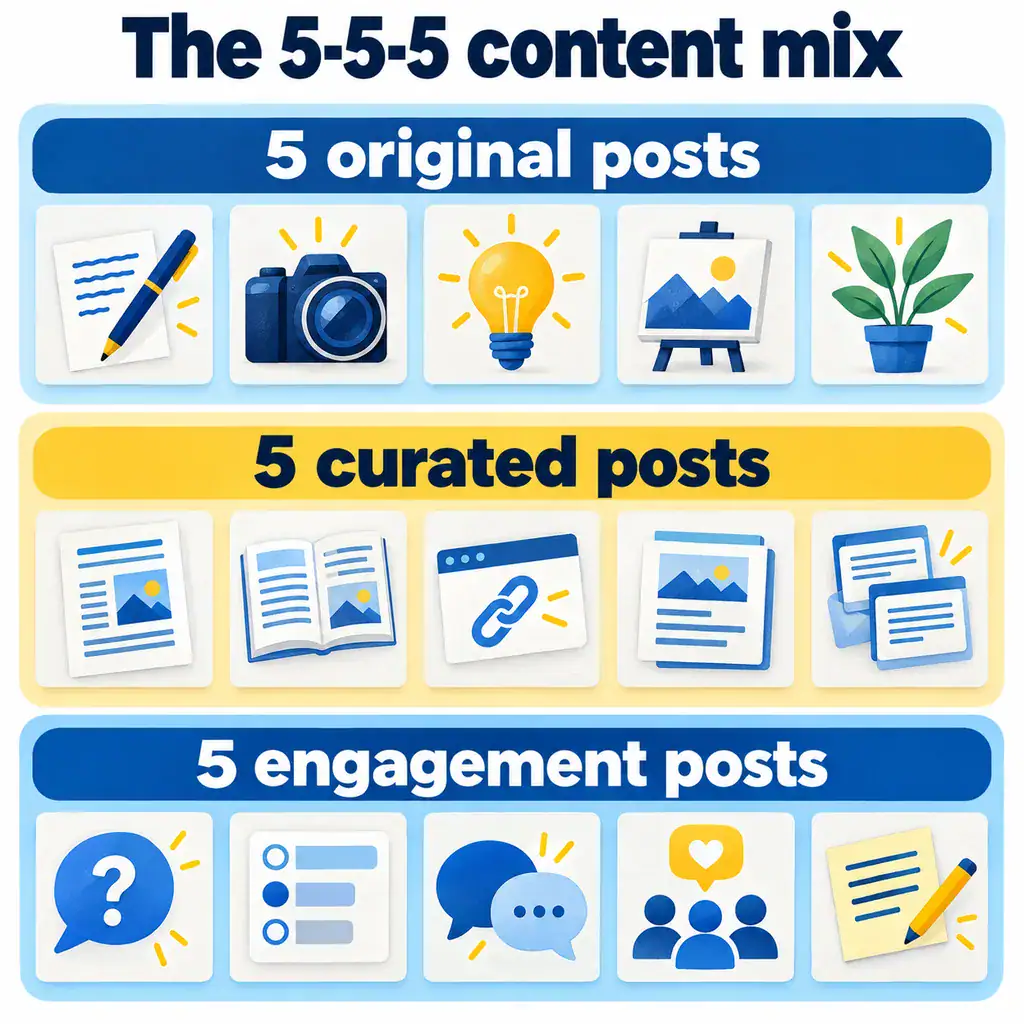
An illustrative mix for generating ideas. Choose the publishing volume and proportions your audience and team can support.
- Original: explain a common question, demonstrate a process or introduce a team member.
- Curated: share a relevant source with your own useful context and credit. Link to the original; do not copy its work without permission.
- Conversation: ask a specific question, invite feedback or use a supported interactive feature when it serves the topic.
Ask permission before republishing customer content, and agree separately on any paid-ad use. Credit does not replace permission. If you give a creator a free product or another benefit for coverage, plan clear disclosure of that relationship. The FTC’s influencer disclosure guide explains the US requirements.
Output: a small bank of post ideas tied to customer questions.
6. Assign the work and publish accessibly
Create a simple calendar showing the topic, channel, format, owner, approval deadline, publishing date and destination link. Batch related filming or photography to reduce setup time, then adapt the assets for each placement.
- Preview the actual post on a phone. Keep essential text away from interface controls and make it readable without zooming.
- Add useful image descriptions where supported and accurate captions for spoken video.
- Check links, price or offer details and permissions before publishing.
- Schedule a volume you can maintain while leaving time for customer replies.
Start with native scheduling tools if they cover the job. A paid scheduler is useful when it solves a real coordination problem. Buffer, for example, supports planning and publishing across supported channels; check current channel, format and plan limits before subscribing.
Design or editing tools can help with production, but they do not replace accurate claims, usable captions and a final human review. Pause scheduled promotions when an event makes them inappropriate.
Output: a short calendar with a named owner for every task.
Need help producing the planned assets?
Sociallyin’s content production team can scope the photography, video, copy and versions your channels need. Bring your goal and content plan to define the work.
Explore Content Production7. Build a manageable response routine
Set a realistic response target based on opening hours, customer needs and staffing. Assign responsibility for comments, messages, reviews and urgent issues. An acknowledgment can explain when a fuller answer will arrive.
- Answer specific questions with useful information, rather than a generic engagement prompt.
- Move account details, order information and other private matters into an appropriate private channel.
- Prepare escalation steps for safety concerns, threats, legal matters and a fast-moving complaint.
- Use automation for clearly defined questions with an easy route to a person; review its answers.
Live Q&As, polls and customer stories can support a community when they answer an actual need. Check account eligibility before announcing a Live. For difficult conversations, use our guide to handling negative comments.
Output: a coverage schedule, response target and escalation owner.
8. Run a focused paid test when the goal calls for it
Advertising can extend distribution or test an offer with a defined audience. It is optional, and it does not guarantee that content will produce sales. Confirm the offer, mobile destination page and tracking before committing spend.
- Set a spend cap, one primary outcome and a review window. Include creative and management costs in the plan.
- Choose a format available for the selected objective and account. Test a clear question, such as one message against another, while keeping other conditions comparable.
- Use the platform’s supported audience controls. Narrower targeting is not automatically more efficient; compare results with enough evidence to judge quality.
- Use customer data and website tracking only with the appropriate permissions and notices. Confirm availability of retargeting and frequency controls for your campaign.
Judge a lead campaign by qualified leads and eventual customers, rather than clicks alone. A low click cost can coexist with poor customer acquisition. If results are inconclusive, investigate the creative, offer, destination and follow-up before increasing spend.
Output: one test brief with a cap, outcome and decision date. Our budget allocation guide explains how to include the operating costs.
9. Measure outcomes and improve one thing at a time
Use platform reports to understand distribution and interaction, then connect tagged website links with analytics, booking records or your CRM. Keep the reporting period and definitions consistent. Platform attribution and a customer’s self-reported source are useful views, but neither alone proves a sale was caused by social media.
| Goal | Primary outcome to review | Supporting evidence |
|---|---|---|
| Qualified inquiries | Qualified leads, appointments and customers | Tagged visits, inquiry source and sales follow-up |
| Purchases or visits | Orders or recorded redemptions, contribution and repeat business | Revenue, returns, discounts and campaign costs |
| Awareness | Reach within the intended audience and relevant brand research | Views, shares and audience feedback, interpreted in context |
| Customer support | Resolution quality and response time during covered hours | Issue volume, escalations and recurring questions |
Define an engagement rate before comparing it: which audience interactions are included, divided by followers, reach or impressions, multiplied by 100. Do not mix denominators or add your own replies to audience engagement without clearly labelling that method.
A simple ROI distinction
Revenue divided by ad spend is ROAS, not profit. For a campaign ROI estimate, compare attributable incremental contribution after variable costs with the full campaign cost. State the assumptions and attribution gaps; with a small sample, report uncertainty rather than claiming a proven return.
Review pacing regularly and make a fuller comparison at the agreed date. Change one major variable at a time where practical. Organic post comparisons are observational, so differences in topic, audience and timing can affect the result. Extend the review when volume is too low to support a decision.
Output: a brief report: what happened, what remains uncertain and what you will change next.
10. Review capacity and decide where support helps
At the monthly review, compare the work required with the time, skills and results available. Keep the activities that serve the business goal, stop unnecessary commitments and update the calendar. Slow follower growth alone is not a reason to buy more services.
Professional help may make sense when production, advertising, community coverage or measurement exceeds your team’s capacity. Ask a potential partner for relevant work, the people assigned to your account, deliverables, approval steps, reporting definitions and a clear separation between service fees and media spend.
Keep account access, product knowledge and business decisions under clear ownership. An agency can support execution while your team supplies customer context, approves claims and handles escalations.
Turn the plan into a first-month routine
- Week 1: DecideWrite the goal, audience, account audit and channel choices.
- Week 2: PrepareBuild a small content batch, test links and assign approvals.
- Week 3: Publish and respondRun the calendar, cover conversations and keep any paid test capped.
- Week 4: ReviewCompare outcomes, costs and capacity; choose the next useful adjustment.
An illustrative sequence. Adjust the pace to your sales cycle and available time.
Need a practical plan your team can run?
Sociallyin’s consulting team can review your channels, responsibilities and measurement, then help prioritize the next steps.
Explore Social Media ConsultingFrequently Asked Questions
What is the best social media platform for my small business?
Choose the channel that fits your customers, business goal and production capacity. Start with customer evidence and a manageable test on one or two platforms. A popular platform is not automatically the best channel for your business.
How often should I post on social media?
Publish at a pace you can sustain while producing useful content and replying to people. Set an initial schedule, review your own performance and adjust. There is no universal posting frequency that guarantees reach.
How can I measure the ROI of my social media efforts?
Record the business outcome, full campaign costs and reporting period. Tagged links, booking records and CRM or order data can support attribution. Compare contribution with costs, distinguish ROI from ROAS and state what the data cannot establish.
Is it necessary to pay for social media advertising?
No. Organic content and customer conversations may serve your goal. A capped paid test can help you reach a defined audience or evaluate an offer, but it needs a working destination, measurement and a spend limit.
How can I create engaging content with limited resources?
Batch simple demonstrations, answers to customer questions and useful behind-the-scenes content. Adapt each asset for its placement, add captions or image descriptions where appropriate, and obtain permission for customer content. Prioritize a few useful posts over a volume you cannot maintain.
The Bottom Line
Start with one business goal, a defined audience and a channel plan your team can support. Use the ten steps to assign work, publish useful content, respond to customers and connect activity to outcomes.
This week, write the goal, audit your profiles on a phone and prepare a small batch of content. Set a review date before adding platforms or increasing spend. Let customer evidence and capacity shape the next plan.