Thought leadership content helps a defined audience understand a problem through original expertise, evidence and a clear point of view. It can be a report, a practical framework, an article or a social post. The format matters less than the useful idea inside it.
This guide explains how to build a thought leadership strategy, evaluate real examples and turn 50 topic prompts into useful content. Explore seven social content examples, four source-linked brand examples and the lessons you can adapt to your own audience.
A quick quality test
Can a reader name the idea, see why they should believe it and use it to make a better decision? If the post only announces a product or shares an inspirational quote, it may support your brand without demonstrating thought leadership.
What Is Thought Leadership Content?
Thought leadership content shares original expertise and a clear perspective that earns an audience’s trust. It explains what is changing, challenges an assumption or offers a better way to solve a relevant problem.
Educational content explains a subject. Thought leadership adds a distinctive, defensible interpretation. A product tutorial can be useful without offering a new perspective; a practitioner’s explanation of when that product category fails may do both.
A credible piece usually combines a specific reader problem, an expert view, supporting evidence and a practical implication. Original research is one source of evidence, but carefully explained first-hand experience, a transparent experiment or a well-supported analysis can also work.
Compare the Three Content Types
These categories can overlap. Use the main job of a piece to judge what it contributes to your content plan.
| Content type | Main job | Illustrative example |
|---|---|---|
| Educational content | Explain a subject or help someone complete a task. | A guide to running a customer-onboarding kickoff. |
| Thought leadership | Offer a distinctive, defensible perspective that helps readers reconsider a decision. | An argument for checking handoff ownership before adding more onboarding automation, supported by a worked case. |
| Personal branding | Help people understand your experience, values and professional identity. | A reflection on what leading an onboarding team taught you about asking for help. |
Illustrative examples, not measured results. A personal story can also demonstrate thought leadership when it adds useful reasoning and support.
How Can Thought Leadership Help Your Business?
Useful ideas can help buyers understand your expertise before they contact you. They can also give your sales team something valuable to share, attract relevant collaborators and create a common language around a difficult issue.
- Trust: show how you reason, including the limits of your advice.
- Recognition: build a consistent association between your brand and a particular problem.
- Conversation: invite informed questions and learn what readers still need.
- Business opportunities: help prospects decide whether your approach fits their needs.
These are potential benefits, not automatic outcomes. Content does not prove product quality, replace customer evidence or guarantee a shorter sales cycle. It works best when you have something useful to say and enough expert time to support it.
Six Principles for Useful Thought Leadership
1. Listen Before Choosing a Topic
Start with sales questions, customer interviews, support conversations, reviews and relevant communities. Record the words people use and the decision they are trying to make. Competitor content can reveal gaps, but it should not be the source of your point of view.
2. Participate in the Conversation
Publishing is only part of the work. Answer follow-up questions, acknowledge counterarguments and add useful context to other people’s discussions. Choose a schedule your experts can sustain without replacing their judgment with generic posts.
3. Go Where Your Audience Already Learns
Choose one primary social channel and one place where readers can explore an idea in depth, such as your website or newsletter. Adapt the same argument to each setting instead of copying identical posts everywhere.
4. Measure What Readers Do Next
Review which topics attract relevant questions, saves, newsletter sign-ups or qualified inquiries. Compare similar reporting periods and record distribution changes. Use the findings to improve your next explanation, rather than copying the most popular competitor post.
5. Make the Expert’s Reasoning Visible
Use specific observations and natural language. Explain why you hold a view, where it applies and what might change your mind. An editor can help shape the piece, but the named expert should verify its claims and approve the final perspective.
6. Bring Evidence and a Useful Next Step
Use an example, a source or a clearly described method. Get permission before sharing client work and remove confidential details. Label hypothetical scenarios and distinguish measured findings from interpretation.
From a Generic Claim to a Useful Insight
How to Create a Thought Leadership Strategy
A strategy connects an audience’s problem to an expert’s perspective, then gives the team a repeatable way to develop and distribute it.
- Define the audience and decision. Replace “business leaders” with a specific role, context and recurring problem.
- Choose a position you can support. State what you believe and what experience or evidence gives you a reason to say it.
- Build two or three content pillars. Group related questions so each piece contributes to the same body of expertise.
- Assign an expert and an editor. Agree who supplies evidence, checks claims and approves sensitive examples.
- Create a flagship piece. Develop one useful report, article or framework, then adapt its insights into smaller posts.
- Plan distribution and review. Choose channels, a sustainable cadence and a small set of measures before publishing.
Thought Leadership Strategy Example
Seven Social Content Examples: What to Learn and What to Improve
These archived posts show the difference between sharing expertise, demonstrating your work and building a personal brand. Screenshots show historical interfaces, job titles and engagement counts. Profile links identify the creators; the examples do not establish campaign results.
1. Kaushal Kakadia: Encouragement and Personal Voice
This motivational message uses a recognizable personal voice. It can help an audience understand the person behind a business, but encouragement alone does not establish specialist expertise.

Idea: Personal voice can make a professional recognizable.
Evidence: The screenshot contains encouragement, but does not show a specialist method or a documented outcome.
Takeaway: Connect the encouragement to a specific decision you made, the constraint you faced and what another practitioner can learn.
Historical personal-brand example: encouragement, rather than a research-backed industry insight.
2. Keith Kakadia: Answer a Concrete Question
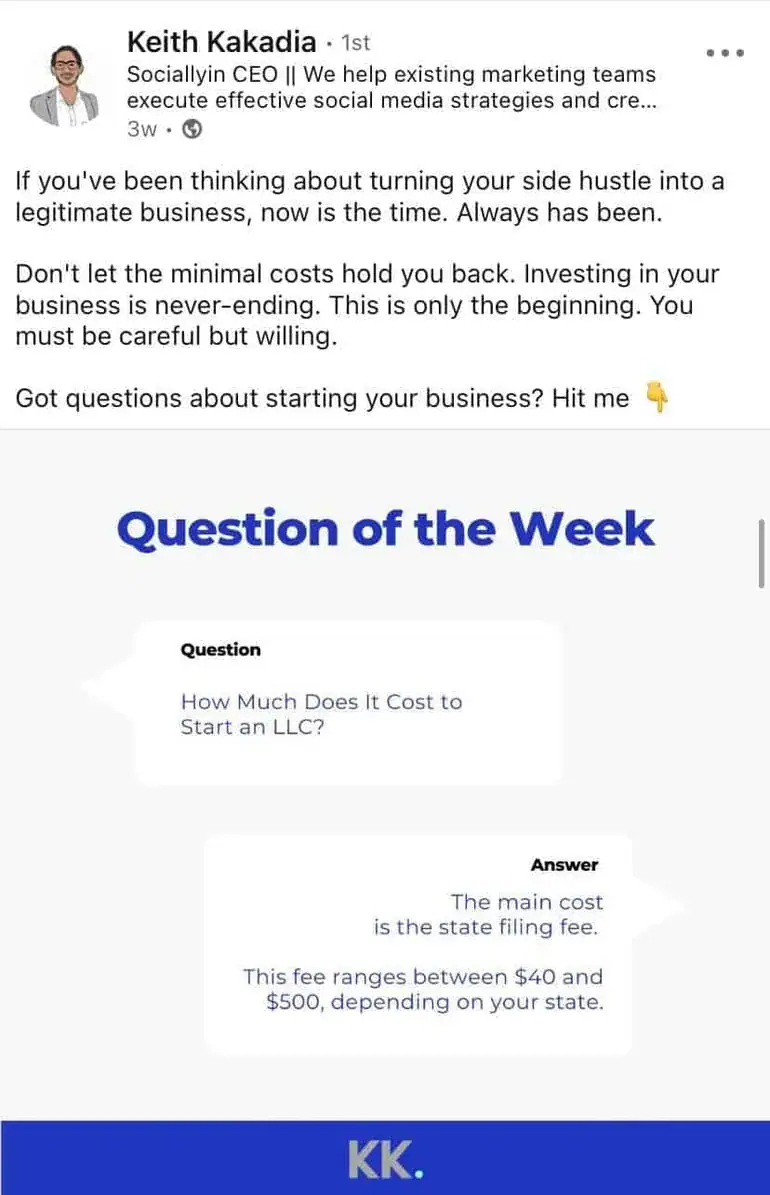
This post invites questions about starting a business and uses a question-and-answer graphic. The useful pattern is specificity: a defined question gives readers a reason to engage.
Keep changing facts current
For topics such as business registration costs, link to the relevant official source and state when you checked it. A specific answer is only useful while its factual context remains accurate.
Apply it: answer one recurring customer question, show the source and invite a useful follow-up. Do not use an old social graphic as evidence for a changing fact.
Historical Q&A example. The filing-cost figures shown are not verified as current; check the relevant state’s official information.
3. Hank Washington: Share Recognition With Context
Hank shares a feature from The Modern College of Design. External recognition can support credibility, but the feature alone does not explain his design method.
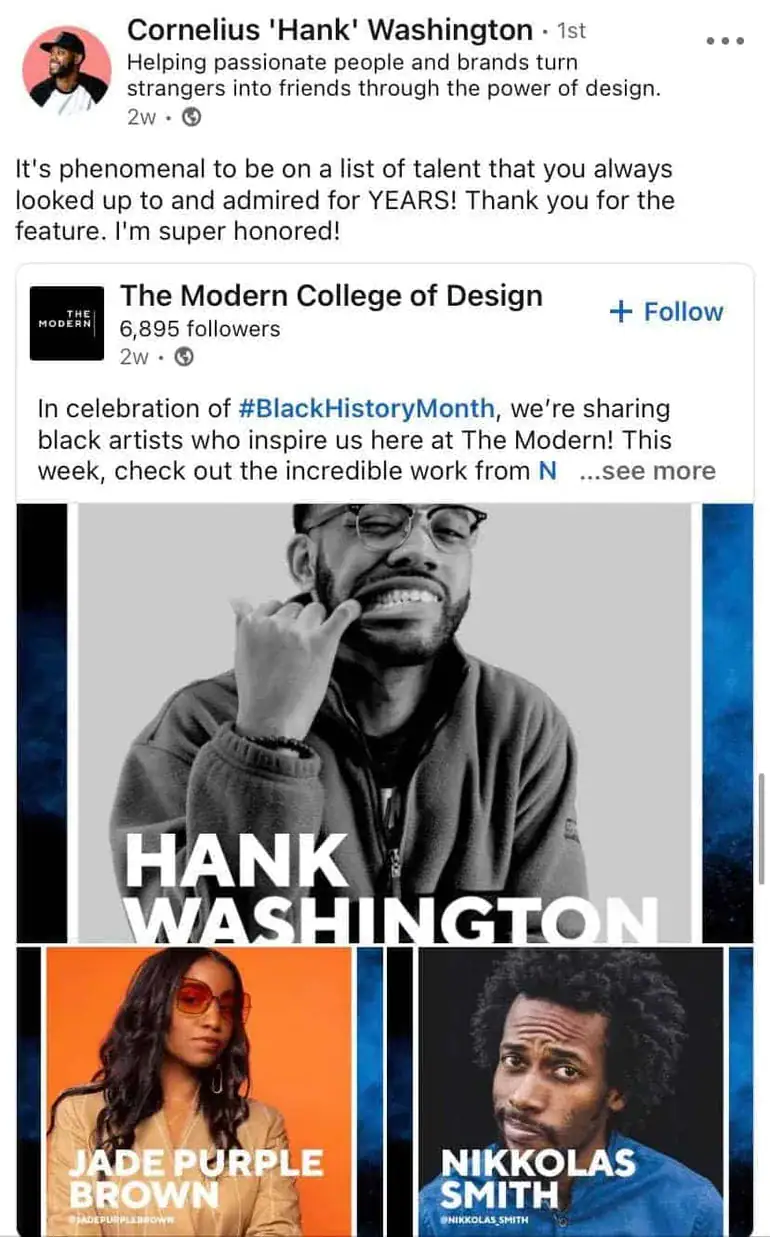
Idea: Third-party recognition can support credibility.
Evidence: The screenshot shows a feature from The Modern College of Design; it does not demonstrate the creator’s design process.
Takeaway: Explain a decision behind the featured work so readers gain something beyond the announcement.
A historical example of sharing third-party recognition.
4. Christopher Shunnara: Demonstrate Your Craft
This post presents a 7UP rebrand concept. Showing work makes a creative approach tangible. The screenshot describes it as a concept, so it should not be mistaken for commissioned or adopted brand work.

Idea: Showing your craft makes an approach tangible.
Evidence: The screenshot presents a speculative 7UP concept, not proof of an adopted redesign or a client result.
Takeaway: Explain the brief, the tradeoff and the reasoning behind one design choice. That turns a portfolio image into a lesson.
Concept work, not evidence of a 7UP client engagement.
5. Marl Jude Roy Macabenta: Curate, Then Add Your Interpretation
Marl’s archived post shares a motivational graphic attributed to Chinkee Tan. Sharing another voice can introduce an idea, but it does not demonstrate your own expertise. Curation becomes more useful when you add a reasoned response.
Apply it: identify what you agree with, where the advice needs qualification and how it applies to a real professional problem. Verify quotations before reusing them.
6. Sannidhya Baweja: Use a Short Claim as a Starting Point
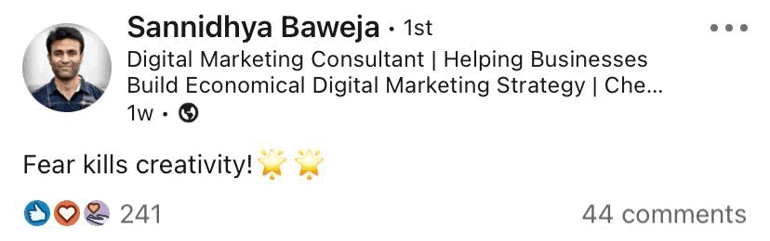
Idea: A short claim can open a professional discussion.
Evidence: The screenshot shows a statement about creativity and historical engagement counts, but no explanation or test of the claim.
Takeaway: Follow a short claim with a concrete example of how a team reduced fear during creative review. A memorable line opens a conversation; the explanation supplies the expertise.
The visible reactions and comments are historical counts, not proof of business impact.
7. Nicolas Bowles: Put Industry News in Context
The archived post reacts to Bumble’s stock-market debut. Its strong visible engagement shows that the post drew attention at the time; it does not establish qualified demand or prove that the same approach will work today.
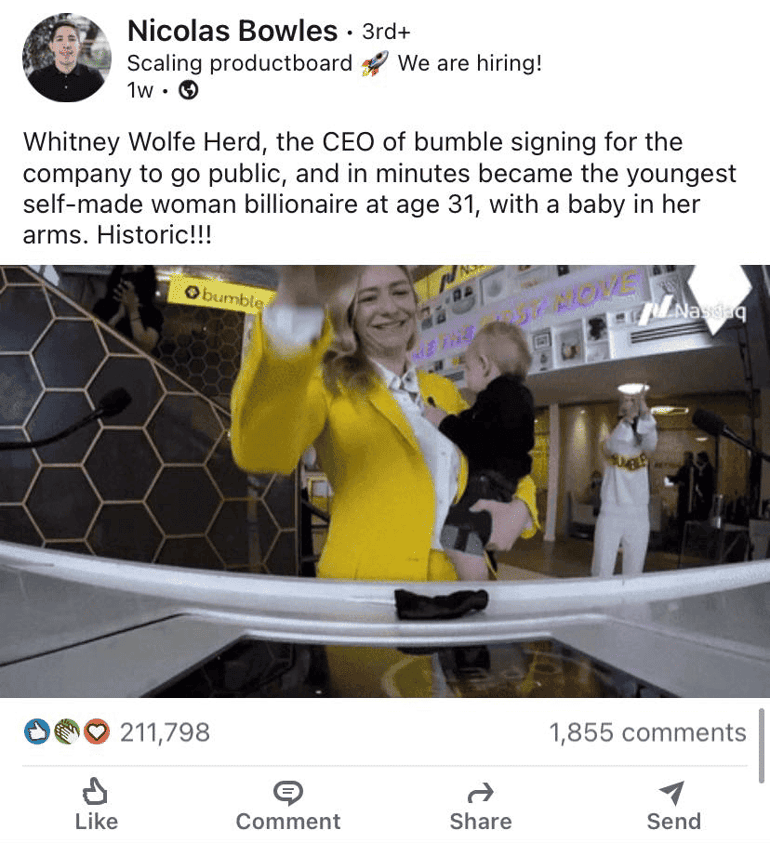
Idea: Industry news becomes more useful when you interpret its implications.
Evidence: The screenshot records a historical reaction to Bumble’s public-market debut. Its visible engagement does not establish business impact.
Takeaway: Explain what a news event changes for your audience, support the factual context with a primary source and offer a practical implication.
A historical news-reaction example; claims in the original post are not current company information.
Four Brand Thought Leadership Examples
These source-linked examples show how companies build a recognizable body of knowledge. The lessons below are editorial interpretations of the formats, not claims that the content caused a particular commercial result.
| Brand and source | Content approach | Lesson to adapt |
|---|---|---|
| HubSpot: State of Marketing | An annual report on marketing trends and practices. | Organize evidence around questions your professional audience needs to answer. |
| Edelman: Trust Barometer | A recurring survey examining trust. | Build a recognizable research theme and make methodology available. |
| McKinsey Global Institute | Research on economic and business issues. | Connect a broad change to a concrete leadership decision. |
| Buffer: Transparent Salaries | Public salary information with an explanation of its approach. | Make a stated principle observable through relevant evidence. |
On phones, swipe the comparison horizontally. Sources checked 28 October 2026.
For B2B brands, thought leadership should reach the decision-makers involved in a purchase. Hey Sid’s guide to B2B thought leadership explores company and executive approaches, with examples and guidance on connecting content to buying decisions.
You do not need a global research budget to borrow these patterns. Start with a narrow question, evidence you can responsibly share and a repeatable editorial method. For more formats, see our content marketing examples.
50 Thought Leadership Topic Prompts
Use these prompts as starting points, not predictions of engagement. Choose a few that fit your expertise, then add a clear audience, evidence and practical takeaway. A tool recommendation or personal story needs that extra layer to become useful thought leadership.
Trend + POV
- Industry predictions (this quarter)
- Overhyped trend (your take)
- News reaction (what it means)
- Skills rising (next 2 years)
- Contrarian “best practice”
- Budget shifts (what to do)
- Favorite chart (your insight)
- Metric being ignored
- Category shift to watch
- What I’d bet on
Lessons learned
- Biggest mistake (and fix)
- What I wish I knew
- Decision that changed outcomes
- Behind-the-scenes workflow
- Habit that improved results
- Hard truth I learned
- Feedback that helped
- Before/after mindset shift
- Career myth I dropped
- Best advice I got
How-to + frameworks
- Checklist for common task
- Weekly framework you use
- 5 beginner mistakes
- Option A vs B guide
- Red flags for X
- 10-term glossary
- Client FAQ answers
- Planning template walkthrough
- When it works/doesn’t
- KPI that predicts success
Data + proof
- Mini benchmark (your data)
- What “good” looks like
- 3 patterns you see
- Myth your data disproves
- Teardown: great example
- Teardown: weak example
- Experiment (what changed)
- What I’d measure first
- 30-day audience challenge
- Simplest tracking method
Community + leadership
- AMA: ask me anything
- Poll + your analysis
- Expert roundup (5 tips)
- Book/podcast: 1 takeaway
- Tool stack recommendations
- Day in the life
- What I’m optimizing now
- Non-negotiable principle
- Values stance (why)
- Case study: problem→approach→outcome
Thought Leadership on Social Media
Social platforms can distribute an idea and make the audience’s response visible. They do not replace the underlying expertise. Choose a format that makes your explanation easier to understand and gives readers a clear path to the full evidence.
Choose a Channel and Format to Test
- LinkedIn: test professional commentary, document posts, articles or expert video when your audience uses the platform for work-related learning.
- X: use concise commentary and source links when timely industry discussion is useful to your audience.
- Instagram and TikTok: demonstrate a method visually, explain a decision on camera or break down an example. Keep captions and labels readable.
There is no universal posting quota. Begin with a schedule your team can support, compare the response and adjust. LinkedIn’s March 2026 feed announcement emphasizes relevant professional insights and action against recycled, low-substance content and inauthentic engagement. It does not establish that long-form content always wins.
Measure Attention, Usefulness and Business Relevance
- Attention: track reach among relevant people and growth in opted-in subscribers.
- Usefulness: review substantive comments, replies, saves where available and references to your ideas.
- Business relevance: record qualified inquiries, invitations and sales conversations that mention a specific piece.
Use tagged links where appropriate and ask new prospects how they found you. Review patterns over comparable periods. Attribution is incomplete, and a content-influenced sale is not proof that content alone caused it. Tie your social media strategy to a defined business goal before choosing the reporting metrics.
Choose a Format That Fits the Idea
Match the format to the explanation your audience needs:
- Research report: when you have a defensible method and enough evidence.
- Practical framework: when readers need a repeatable way to make a decision.
- Case analysis: when you can explain a problem, approach, outcome and limitation.
- Expert article or newsletter: when an argument needs context and sources.
- Video demonstration: when seeing the method makes it easier to understand.
- Webinar or Q&A: when questions and counterarguments will improve the explanation.
- Social post or carousel: when one focused insight can stand alone and lead to deeper evidence.
- Podcast or interview: when a conversation reveals useful reasoning or experience.
A contest, unboxing or pet photo may belong in a broader content plan. It becomes relevant here only when it carries a useful professional insight.
Frequently Asked Questions
What is thought leadership in a sentence?
Thought leadership is the practice of sharing original expertise and perspective so consistently that your audience starts treating you as a go-to authority.
In one sentence: it’s earning influence through the quality of your ideas, rather than the size of your ad budget.
Strong thought leadership teaches, challenges assumptions, and gives people something actionable to use right away.
What is thought leadership marketing?
Thought leadership marketing is a content strategy where a person or brand builds trust by publishing expert insights, original research, or a clear point of view, without leading with a sales pitch.
The aim is to earn relevant inquiries, partnerships or media interest over time. Those outcomes are possible, but they are not guaranteed by publishing more often.
What are examples of thought leaders?
Examples of thought leaders include individuals like:
- Simon Sinek (leadership)
- Brené Brown (vulnerability and workplace culture)
- Gary Vaynerchuk (entrepreneurship and social media)
Plus brands like:
- McKinsey (strategy research)
- HubSpot (marketing benchmarks)
- Patagonia (values-led sustainability messaging)
What they share is consistency, a distinct point of view, and content that helps the audience think and act differently, rather than just promotional posts.
What are the best thought leadership topics for social media?
The best thought leadership topics for social media sit at the intersection of what you truly know and what your audience is actively struggling with.
Useful starting points include trend predictions with a clear POV, lessons learned from real work, mini case studies, original data or benchmarks, and simple frameworks/checklists.
Test a short story with a practical takeaway against other formats, and judge the quality of the responses from your intended audience.
How do you measure thought leadership success?
Measure thought leadership on three levels:
- Awareness (reach, subscriber growth, media mentions)
- Engagement (comments, saves, replies, time on page)
- Business impact (inbound inquiries, sales conversations that reference your content, win rate for engaged prospects).
Track one primary metric per level so reporting stays simple.
A useful qualitative signal is when customers quote your ideas back to you or share your frameworks internally. Content-influenced inquiries do not, by themselves, prove that content caused a sale.
The Bottom Line
Build thought leadership around one audience, one meaningful problem and a perspective you can defend. Show your reasoning, support the claims and give readers something useful to do next.
Start with one strong piece, adapt it for the channels your audience uses and learn from the response. Judge progress by relevant conversations and business signals as well as reach.

Need help turning expert insight into a consistent social presence? Explore Sociallyin’s social media strategy services, or tell us about your goals below.