You built the personas. You mapped content pillars. The calendar is full, and the goals are documented. And engagement is still flat.
Here’s the part most “why isn’t my social working” advice gets wrong: it treats platform mismatch as one bullet buried in a list of six unrelated causes. Budget, consistency, data, goals, and somewhere in there, “tailor to each platform.” That framing hides the actual diagnosis.
Content strategy and platform fluency are two separate jobs. A strategy defines what to say, to whom, and why. Platform fluency is whether the algorithm and the audience actually receive it in a form that feels native to the feed. Most teams only ever audit the first one.
That’s the gap. Your social media engagement strategy can be sound while your execution layer quietly fails. And the execution layer breaks down into three fixable things: format, voice, and timing. None of them require rebuilding your strategy.
All three can be diagnosed and adjusted this week, which is what the rest of this piece walks you through.
Key distinction:
Format, voice, and timing are execution problems, not strategy problems. You can diagnose and fix all three this week without touching your personas, pillars, or goals.
Your strategy isn’t the problem. Your execution layer is.
Run a quick test. Pull your engagement rate by platform for the last 30 days. If one channel performs and two don’t, and the underlying message is roughly the same across all three, the message isn’t the variable. The execution is.
That’s the situation a Director of Social lands in more often than a broken strategy. The pillars make sense. The audience is defined. But social media engagement lands inconsistently across channels, and it’s hard to tell whether the fix is a bigger, slower strategy project or something faster.
Platform fluency is the faster answer, and it’s the one worth ruling in or out first. Before you request more budget or headcount, confirm whether your content is failing because of what it says or because of how it shows up in each feed.
The distinction matters because the two problems have completely different price tags. Re-running strategy means re-running research, personas, and positioning.
Fixing execution means adjusting format, register, and cadence on content you’re already producing. This article is a diagnostic for the second one.
Flat engagement despite posting consistently?
SociallyIn’s outbound engagement team initiates personalized conversations, replies within engagement windows, and builds the community signals that platforms read as account activity. Built for Directors of Social who want to drive conversations rather than wait for them.
What platform fluency actually means (and why it’s distinct from strategy)
Platform fluency is understanding how content behaves in each platform’s feed, then adapting format, voice, and timing so your content feels native to that specific environment. It’s not “platforms are different.” It’s knowing precisely how they differ and building for it.
A native post reads as if it belongs. It matches what the audience on that channel came for, in the format they expect, in a register that sounds like the platform rather than like a press release. When content clears that bar, it earns more interaction signals, and those signals are what distribution runs on.
The psychological mechanism underneath this is cognitive fluency: the easier something is to process, the more we trust it and the more likely we are to act on it. Content that feels imported creates friction, and friction reads as “scroll past.”
This is where the two-layer model gets practical. Strategy owns the message. Fluency owns the delivery.
A social media agency that only sells strategy hands clients a plan that can still underperform in the feed, because a sound social media engagement strategy assumes native execution it doesn’t actually control.
| Dimension | Content Strategy | Platform Fluency |
|---|---|---|
| What to say | Defines the message, claims, and topics | Adapts message delivery to each feed’s norms |
| To whom | Defines audience personas and segments | Matches tone and register to that platform’s users |
| Why | Sets goals, KPIs, and business rationale | Connects those goals to platform-specific signals |
| How to say it natively | Not in scope | Format, voice register, cadence, and native features |
The table makes the split concrete. If your failure mode is “right message, wrong format,” you don’t have a strategy problem. You have a fluency problem, and it lives in one of three levers.
The three-lever framework: format, voice, and timing
Platform fluency reduces to three adjustable levers. Each one is fixable without touching your strategy, and each has a distinct failure signature you can spot in your analytics.
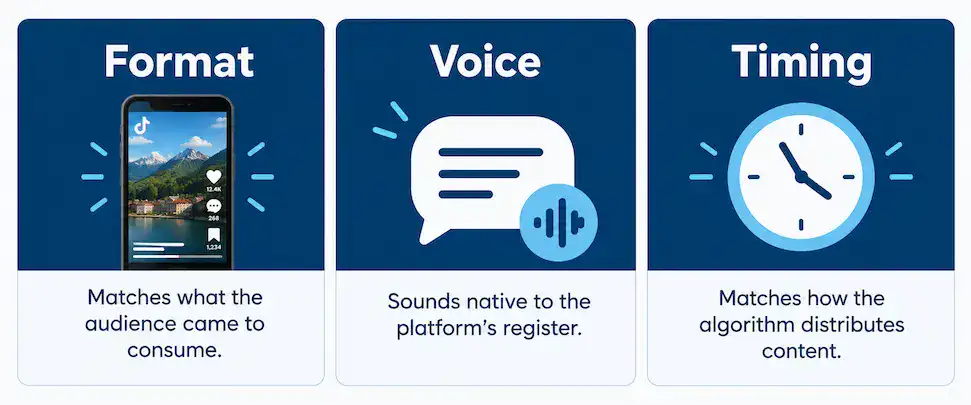
- Format is whether your content matches what the platform’s audience came to consume.
- Voice is whether your copy sounds native to the platform’s register.
- Timing is whether your release and cadence match how the platform’s algorithm actually distributes content.
Diagnose all three, and you’ll know which one is costing you.
Lever 1: Format; build natively, not by repurposing
Format fluency means creating content for what each platform’s audience expects to see, not slicing an existing asset to fit three feeds at once. Repurposing without adaptation is the single most common execution failure, and it’s easy to spot once you know the shape of it.
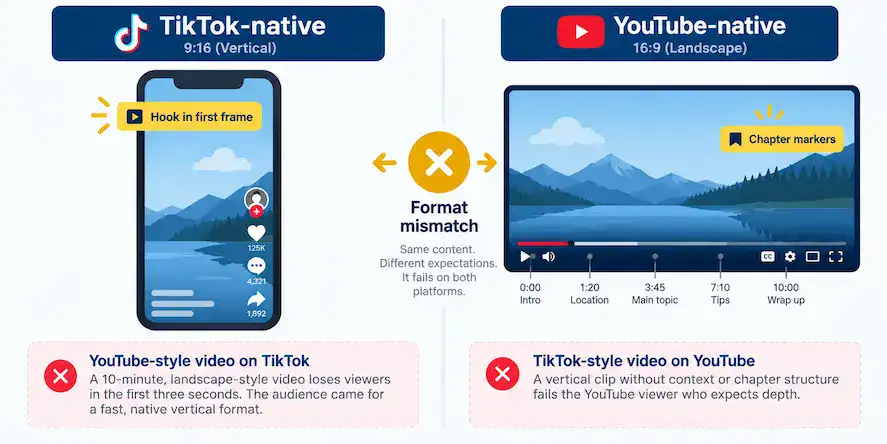
The main format classes each carry their own expectations. Short-form vertical video (9:16, under 60 seconds) rewards a hook in the first frame. Carousels reward saves and completion as people swipe.
Stories reward taps and quick replies. Infographics reward shares. Native text posts, tight on LinkedIn and short on Instagram, reward comments and dwell.
When you match content format to what the feed favors, you earn the interaction signals that feed distribution. A carousel that gets saves tells Instagram the content has lasting value. A vertical clip watched to completion tells TikTok to keep showing it.
Native features (polls, Stories stickers, Q&As, Lives, carousels) are part of format, not a garnish. These are formats the platform built and actively pushes. Using them at least once a week signals that you’re publishing the way the platform wants you to, and that alone can shift how much reach your other posts get.
Lever 2: Voice; same message, different register
Brand voice and tone should flex by platform without losing the identity underneath. The message stays constant. The register (how compressed, how casual, how trend-aware) changes to match how people read on that channel.
LinkedIn rewards compressed, insight-dense copy that provokes professional debate. TikTok and Instagram reward casual, conversational lines that lead with the audience’s felt experience. Twitter/X rewards ultra-compressed, binary statements that share well. Same claim, three different deliveries.
| Platform | Register Characteristics | What Changes From Your Baseline |
|---|---|---|
| Visual-first, aspirational-casual, short captions | Shorter sentences, more white space, lead with feeling | |
| TikTok | Casual, direct-to-camera, trend-aware | Conversational opener, audience-first framing, informal phrasing |
| Compressed, insight-dense, professionally direct | Tighter paragraphs, stronger claim up front, professional debate angle | |
| YouTube | Educational, structured, chapter-friendly | Longer-form explanation, clear section logic, depth over brevity |
| Community-oriented, conversational, shareable | Warmer tone, question-driven endings, story-friendly structure | |
| X | Ultra-compressed, binary, share-optimized | Single strong claim per post, no hedging, built to quote-post |
Notice what stays the same across those rows: the underlying point that strategy and execution are different jobs. What changes is register, not identity. That’s the skill.
Cognitive fluency does the rest, because copy that sounds native to a feed is easier to trust and easier to act on than copy that reads like it was pasted in from a brand deck.
The common failure here is organizational: approval processes flatten personality out of copy, especially when reviewers aren’t fluent in the platform. Every round of “make it more on-brand” tends to pull writing toward generic, and generic is exactly what feeds punish.
Platform fluency in voice means the copy is allowed to sound like the platform, not like a compliance memo.
Lever 3: Timing; match cadence to how each platform distributes content
Timing isn’t “post at 9am on Tuesday.” It’s understanding which signals each platform’s algorithm weights, then releasing content in a way that feeds those signals.
Matching your content’s release cadence to the right signals looks different by platform: completion rate on TikTok, dwell time and shares on LinkedIn.
Consistency, not just clock time, keeps you in active rotation. Publishing too infrequently on TikTok drops your distribution momentum in a way that’s harder to recover than a quiet week on LinkedIn; same content strategy, different reward function depending on the platform.
For the platform-by-platform time-slot specifics, see our existing guide on best times to post; there’s no reason to duplicate that data here. The point for this diagnostic is simpler: timing is adjustable without rebuilding a single piece of creative. You’re changing when and how often, not what.
Platform fluency audit: how to diagnose which lever is broken
Step one: Run this as a one-week diagnostic. You’re not rebuilding your social media engagement strategy; you’re isolating which of the three levers is dragging your engagement rate down on which platform.
- Pull the last 30 days of performance data by platform and filter by content format type.
- For each platform, compare your top-performing post format against what native organic content from non-brand accounts looks like, and note the format gaps.
- Read the copy of your last 10 posts on each platform aloud. Does it sound like it was written for that platform’s register? Flag anything that reads like it was pasted from another channel.
- Check posting frequency and last-five-post timing against your own analytics’ best-time data, not a generic guide.
- Count how many comments and DMs received a reply within 2–4 hours over the last two weeks.
Step two is where format problems surface fastest. If your best post still underperforms native accounts, your ceiling is a format ceiling. Watch specifically for underused native features: polls, Stories, Lives, carousels; if they never appear in your last 30 days, that’s a format gap the platform notices.
Step three isolates voice: copy that reads fine on a page but wrong out loud is copy that hasn’t been written for the feed.
Step four isolates timing: if your posting frequency and time slots don’t match what your own analytics show as your audience’s active window, you have a cadence problem, not a content problem. Step five surfaces the timing-and-response habit most audits skip entirely.
Whether you’re an in-house lead or a social media agency running this for a client, the output is the same: one lever with the biggest gap. Fix that first. The checklist below lets you run all three levers per platform and see which one needs attention this week.
Platform Fluency Audit Checklist
Check off each item for the platform you’re diagnosing. The section with the most unchecked items is your highest-priority lever to fix this week.
Downloadable resource
Platform Fluency Cheatsheet: Format, Voice & Timing by Channel
PDF – 33.5 KB – Cheatsheet
Two-way engagement: the execution habit most audits miss
Engagement isn’t only what your content receives. It’s also what your account does: the comments your brand leaves, the DMs you initiate, the accounts you reply to first. Most audits measure inbound and ignore outbound entirely.
The execution habit most teams skip
Inbound metrics tell you how content performs. Outbound habits (what your account does, not just what it posts) shape how the algorithm classifies your account over time.
Consistent replies and proactive outreach build community signals that distribution systems read as “active account.” A brand that answers comments within 2–4 hours and starts conversations in DMs looks alive to the algorithm in a way a broadcast-only account never does.
Native features double as outbound tools. A poll invites a response you can reply to. A Q&A sticker opens a thread you can extend.
When you calculate engagement rate, count these interactions too, because they reflect the relationship-building that keeps an audience coming back and keeps your content in circulation.
Why content calendars and approval workflows kill platform fluency
Structured calendars and multi-round approvals are how good teams stay organized. They’re also how platform fluency quietly dies. The failure isn’t individual; it’s systemic, and it produces content that clears internal review but fails the feed.
Why your approval process might be the problem
When every post requires three rounds of sign-off, two things happen: trend windows close before you can publish, and reviewers who aren’t platform-native flatten copy toward brand-safe generic language.
- Fix for format: require platform-native briefs, not asset repurposing requests.
- Fix for voice: add a platform-register review step, not just brand-voice review.
- Fix for timing: define a fast-track approval path (under 24 to 48 hours) for trend-responsive content.
The pattern shows up as late trend adoption, generic visuals, and personality sanded out of copy. Everyone is executing “correctly” against the calendar, and the calendar is exactly what’s creating the gap between strategy intent and feed reality.
Each lever has a structural fix, not a heroic one: brief for native format from the start, review voice at the platform-register level rather than the brand level, and give trend-responsive posts a lane that skips the full approval gauntlet.
Test, measure, iterate: keeping platform fluency current
Platform behavior changes, so fluency is never finished. What earned reach last quarter can flatten this quarter when the algorithm reweights its signals. Testing is how you stay current without guessing.
Start with the highest-delta lever from your audit. If format is the gap, test format variants first: a carousel against a single image, a native vertical clip against a repurposed one.
If voice is the gap, test hooks written for the specific feed against your current defaults. If timing is the gap, test posting cadence and release windows.
Read format-specific metrics, not just likes. Completion rate tells you whether video format and length fit. Saves tell you whether a carousel earned lasting value.
Replies tell you whether a conversational post or poll actually opened a two-way exchange. Native features give you the clearest read here, because their metrics are purpose-built.
Persist when a variant beats your baseline across at least three posts; iterate when it doesn’t. Structure the whole thing around content pillars and content series so your tests stay comparable, and so a winning format becomes a repeatable series rather than a one-off. That’s how platform fluency compounds instead of resetting every month.
| What to test | What to measure |
|---|---|
| Carousel vs. single image | Saves, completion rate. |
| Feed-specific hook vs. current default | Replies, watch time. |
| Cadence and release window | Reach consistency over 2 weeks. |
Frequently Asked Questions
Want an outside audit of your execution layer?
SociallyIn’s consulting team audits format, voice, and timing per platform and hands your internal team a prioritized fix list, not a strategy rebuild.
Built for CMOs and Directors of Social who have a plan but need a second set of eyes on execution.
The bottom line
Before you rebuild your strategy or ask for more budget, rule out the cheaper problem first. Run the one-week audit, use the checklist to score format, voice, and timing per platform, and fix the highest-delta lever.
If your message is sound and your engagement is still flat, the fix is almost certainly in the execution layer, and it’s faster than the rebuild you were bracing for.