Two weeks. That’s all the time standing between your blank content calendar and a fully running Easter campaign that drives real visibility, engagement, and sales.
For many business owners, late-stage holiday planning feels like a disadvantage, but the window ahead is more than workable. It’s an opportunity to move fast, stay focused, and cut through the noise with campaigns that feel timely rather than overproduced.
The numbers make a compelling case for showing up.
U.S. consumers were projected to spend $23.6 billion on Easter-related purchases, signaling a massive seasonal revenue window for brands willing to act with intention. And social media is precisely where that opportunity lives.
Approximately 72.9% of internet users use social platforms to research products before buying, meaning your next post could be the deciding factor between a browser and a buyer.
What follows is a practical playbook built for speed and clarity. You’ll find platform-specific content ideas for Instagram, TikTok, Facebook, and more.
We cover gamification tactics, urgency-driven strategies, and visual content ideas designed to stop the scroll and drive engagement.
Beyond the ideas themselves, you’ll also walk away with a ready-to-use two-week execution checklist, paid social guidance, and a measurement framework to track what’s actually working.
Whether you’re a solo marketer or managing a team, everything ahead is built for real-world constraints: limited time, lean budgets, and the need to see results quickly. Pick your starting point, and let’s get your Easter campaign moving.



Why Easter Is A Golden Window For Social Media Marketing
Not every holiday delivers the same commercial weight.
Easter does.
It combines broad cultural participation, rising consumer spending, and strong seasonal emotions, making it one of the most underutilized marketing windows on social media. If your brand has treated Easter as a secondary holiday, the data suggests it deserves more attention.
Easter Marketing Statistics & Consumer Trends
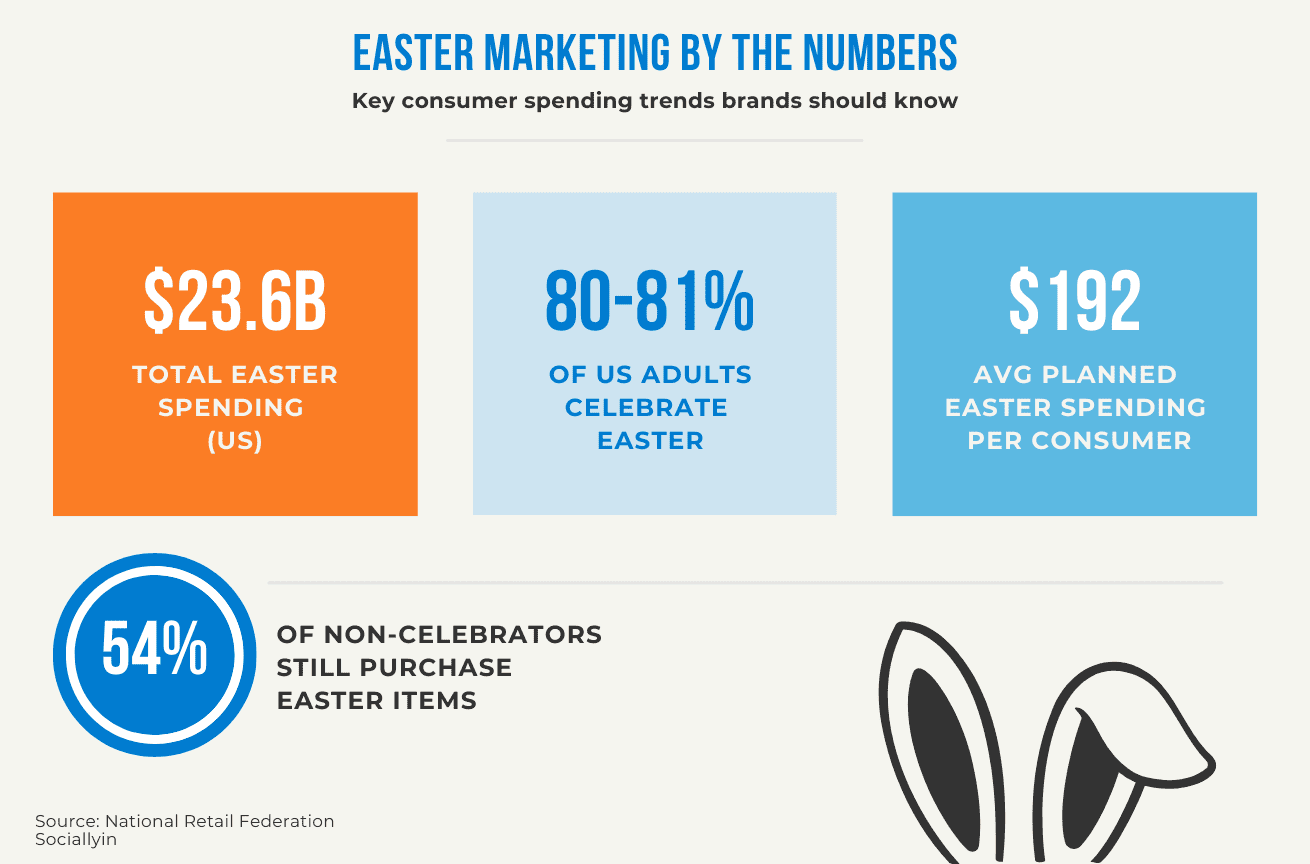
Recent forecasts place U.S. Easter spending at more than $23.6 billion, continuing a steady upward trend.
Participation is equally strong:
- 80–81% of American adults celebrate Easter in some form, creating a large seasonal audience.
- Average planned spending is projected at about $192 per person in 2025.
- Even among people who don’t celebrate the holiday, 54% still plan to spend around $25 on seasonal items.
That last figure reveals an important secondary audience. Many brands focus only on traditional Easter shoppers, overlooking consumers who participate through seasonal purchases rather than the holiday itself.
The Economic Power Of Easter And What It Means For Your Brand
Let’s translate those statistics into practical business terms. Easter spending spreads across multiple retail categories rather than concentrating in one:
| Category | Projected Spend |
|---|---|
| Food | Over $7.3 billion |
| Clothing & Apparel | Approximately $3.5 billion |
| Gifts | Approximately $3.8 billion |
| Candy | Approximately $3.3 billion |
Here’s why this matters for brands outside the obvious categories: Consumer behavior is also shifting toward non-traditional Easter purchases such as DIY crafts, gardening items, toys, and lifestyle products.
In other words, far more brands can participate in Easter marketing than the typical candy or grocery retailer.
The holiday also drives a noticeable surge in online shopping. Historically, eCommerce sales increase by more than 10% during the Easter period, meaning many consumers are already in a buying mindset before the holiday arrives.
Your job is simply to meet them there.
How Social Media Amplifies Easter Campaigns Faster Than Any Other Channel
Traditional advertising channels often require long planning cycles. Social media operates differently.
A well-timed post can reach thousands of people within hours, and platform algorithms tend to reward seasonal content that generates quick interaction.
Gamified campaigns illustrate this well. Digital egg hunts, contests, and interactive challenges have been shown to increase brand reach by up to 152%, making them especially valuable for businesses working with smaller marketing budgets.
Additional data reinforces the opportunity:
- 29% of Easter shoppers are motivated by promotions and discounts
- 26% begin shopping weeks before the holiday
Together, these trends make early social campaigns particularly effective.
The Emotional Triggers Behind Easter That Drive Engagement (Spring, Renewal, Community)
Beyond spending behavior, Easter carries emotional themes that naturally perform well on social media: spring, renewal, family gatherings, and celebration.
Content that taps into these themes (seasonal visuals, nostalgic traditions, or playful holiday moments) is more likely to be shared and saved. That emotional connection matters. When audiences associate your brand with positive seasonal moments, it strengthens familiarity and trust beyond a single campaign.
Why Two Weeks Is Actually Enough Time To Launch A Winning Campaign
It’s a fair concern: can a campaign planned and executed in two weeks actually deliver meaningful results? The short answer is yes, provided you work with what you already have rather than building everything from scratch.
Effective short-window campaigns typically:
- Reframe existing products or offers through a seasonal lens
- Use low-production formats like Reels, Stories, polls, and carousels
- Leverage platform-native features such as countdown stickers, UGC challenges, and interactive posts
The compressed timeline also creates natural urgency. Rather than over-engineering a campaign, teams focus on the tactics most likely to drive results.
The strategies that follow, from interactive contests and gamification to urgency-driven content and a two-week execution checklist, are designed to help you maximize that window.

Launch Your Easter Campaign Before the Window Closes
You don’t need months of planning to make Easter marketing work. If you want a focused campaign built around your audience, offer, and timeline, we can help you map it out quickly.
Interactive Social Media Contests & UGC Campaigns That Get People Talking
One of the most effective ways to build momentum during a short campaign window is to stop broadcasting and start inviting participation.
Contests and user-generated content (UGC) campaigns shift the relationship from brand-to-audience to brand-with-audience. When followers become participants rather than passive viewers, your content reaches more people, and your campaign produces assets you can continue using long after Easter.
How To Run A Branded Hashtag Easter Contest That Builds Community Fast
A branded hashtag contest is one of the fastest ways to drive participation with minimal production resources.
The concept is simple: create a memorable campaign hashtag, define a single action for participants, and offer a reward.
Keep the entry action easy:
- Share a photo of their Easter table setting
- Post a spring outfit or celebration moment
- Show how they’re using your product during the holiday
Then ask them to tag the post with your campaign hashtag.
The lower the barrier to entry, the higher the participation rate.
A helpful reference comes from retail company Nisa, which ran a campaign encouraging users to find hidden Cadbury eggs in stores and post photos using a branded hashtag for a chance to win a prize. The campaign worked because it connected a simple action with a playful challenge.
Your version doesn’t need a national prize budget. The principle translates easily to social-first campaigns.
When creating your hashtag, keep it short and brand-adjacent:
- #[YourBrand]EasterHunt
- #[YourBrand]SpringShare
Launch the hashtag by posting your own content first, then promote it through Stories, captions, and direct engagement with followers.
User-Generated Content Campaigns: Inviting Followers To Share Their Easter Moments
UGC campaigns work especially well during Easter because people are already sharing seasonal activities: decorated eggs, family gatherings, spring baking, and festive outfits.
Your campaign simply gives those posts a destination.
Encourage followers to share their Easter experiences using your hashtag and highlight that the best entries may be featured on your profile. That visibility alone is a strong motivator.
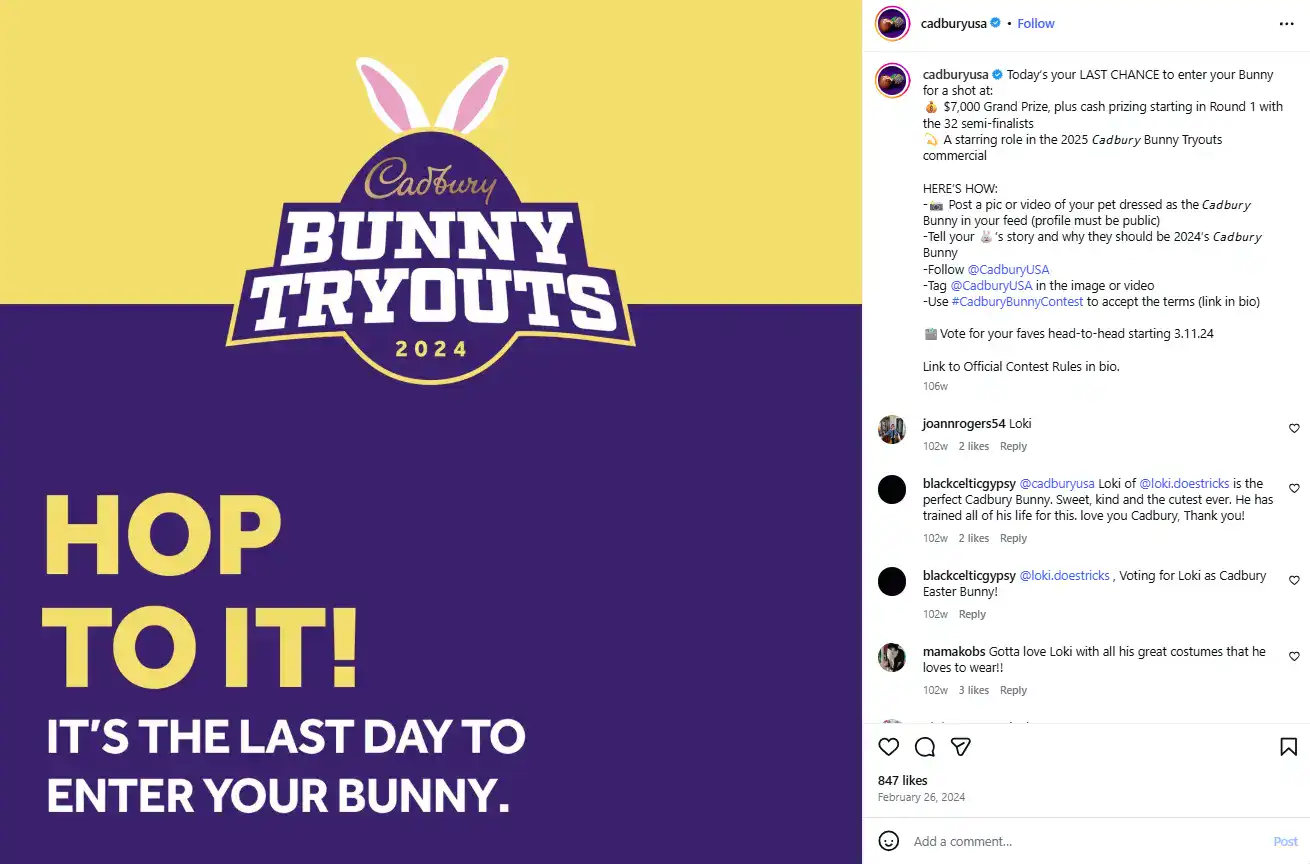
Cadbury’s “Bunny Tryouts” campaign illustrates this well. The brand invited users to submit photos of pets wearing bunny ears for a chance to appear in a commercial. The audience created the content while the brand provided the stage.
The same idea works at any scale.
Invite followers to share Easter recipes, crafts, or spring outfits using your branded hashtag. Keep the theme broad enough for wide participation but relevant to your brand.
Photo Contests And Caption Challenges That Drive Shares And Saves
Photo contests and caption challenges are two of the most comment-friendly formats available on social media.
Photo contests invite followers to submit seasonal images for a chance to win a prize. Tiered rewards (such as “most creative,” “funniest,” or “most-liked”) help maintain engagement throughout the contest.
Caption contests take the opposite approach. Post a single Easter-themed image and ask followers to write the best caption in the comments. This format generates high comment volume, which signals value to platform algorithms.
Another reliable format is the “guess the amount” contest:
- Post a jar filled with mini chocolate eggs
- Ask followers to comment their guess
- Reward the closest answer
Each of these formats works because it gives participants a clear, low-effort action, which is exactly what drives large-scale engagement.
How To Partner With A Complementary Brand For A 48-Hour Easter Basket Giveaway
Brand partnerships expand reach without expanding your budget.
A 48-hour Easter basket giveaway co-hosted with a complementary brand allows both partners to access each other’s audiences.
Look for brands with overlapping audiences but non-competing products, such as:
- A bakery and a local florist
- A children’s clothing brand and a toy shop
- A wellness brand and a specialty food retailer
Structure the giveaway with simple entry requirements:
- Follow both accounts
- Like the post
- Tag a friend in the comments
The 48-hour window creates urgency and concentrates participation instead of spreading it over a longer period.
Both brands should publish the giveaway simultaneously and cross-promote it across Stories and feed posts.
Tips For Moderating, Amplifying, And Repurposing UGC Content After The Campaign
Running the contest is only part of the process. What you do with the content afterward determines much of its long-term value.
During the campaign:
- Check entries follow contest rules
- Respond to comments to maintain momentum
- Save standout submissions for potential features
Instagram’s tagged-post tools make it easy to build a library of approved UGC.
After the campaign ends, extend its value by:
- Featuring top submissions on your feed or Stories
- Repurposing UGC in email campaigns or product pages
- Using strong submissions in paid social ads (with permission)
One compliance note: include a short disclosure in your contest caption, such as:
“By entering, you grant [Brand Name] permission to repost your submission with credit.”
Setting expectations up front protects your brand while building trust with participants.
Gamification & Digital Easter Experiences That Boost Engagement
Interactive contests invite participation. Gamification takes that a step further by making participation enjoyable.
There’s a meaningful difference between asking someone to enter a giveaway and giving them an experience they want to return to. That distinction separates a forgettable seasonal post from a campaign that builds real brand familiarity.
The numbers support this approach:
- Gamified marketing campaigns generate engagement rates 100–150% higher than traditional, non-interactive content.
- Interactive content is shared up to 12× more frequently than static posts, expanding organic reach without increasing ad spend.
For a two-week Easter campaign, gamification is one of the most practical ways to compete above your budget tier.
How To Host A Virtual Easter Egg Hunt Across Your Social Media Profiles
A virtual Easter egg hunt is one of the most adaptable gamification formats available.
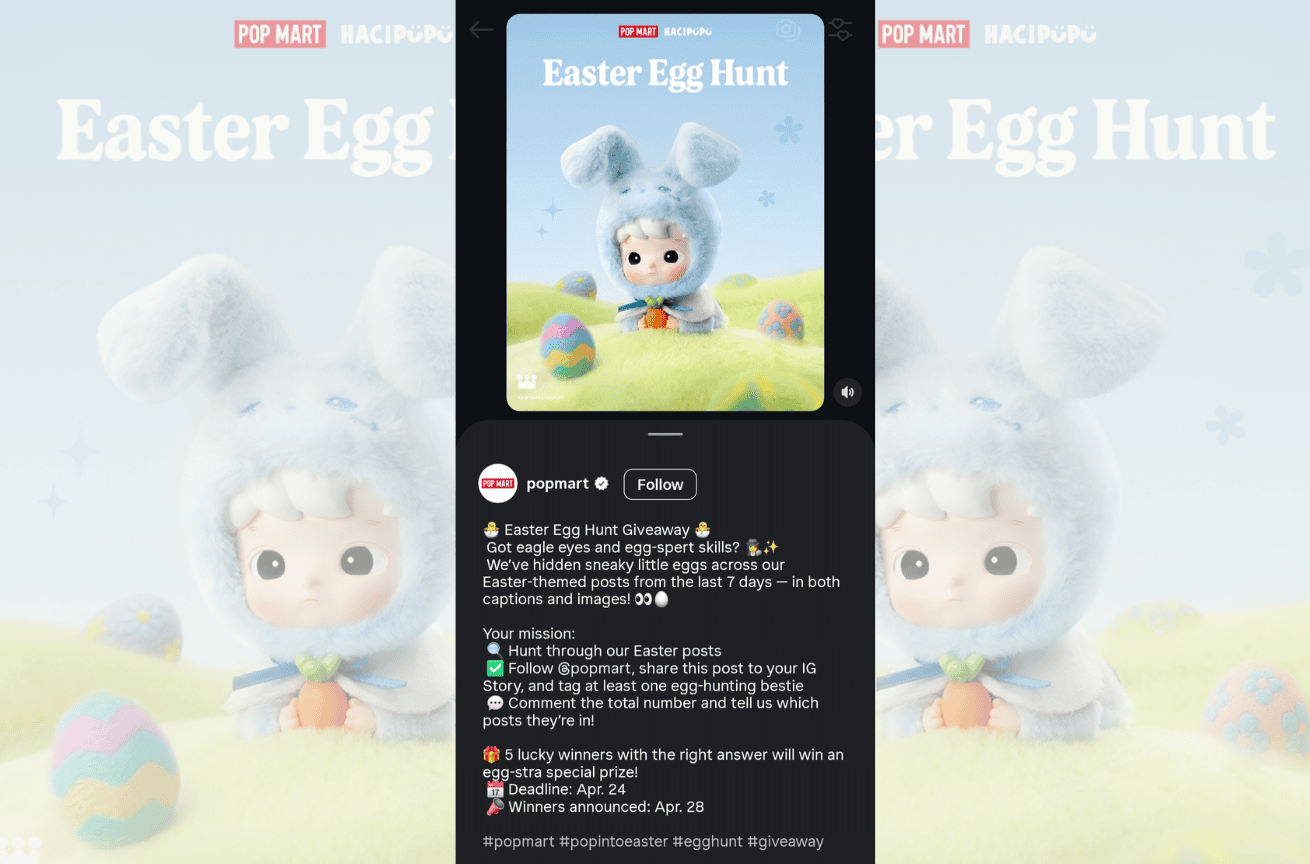
Hide digital eggs as emoji overlays, subtle graphics, or clickable icons across your posts, Stories, website pages, or email newsletters. Followers who find them unlock a reward such as a discount code, free gift, or early product access.
Each egg placement can guide users toward content with a commercial purpose:
- An egg on a product page drives product discovery
- An egg in a Story about a new collection builds launch awareness
- An egg in an email newsletter reconnects dormant subscribers
You’re not just creating a game; you’re guiding users through your brand ecosystem.
To run the hunt effectively:
- Hide egg emojis across posts, Stories, or website images
- Offer a reward to users who find them all
- Limit the number of winners to add urgency
- Use a countdown sticker to signal when the hunt ends
- Post daily “spot the egg” prompts to encourage repeat visits
Repeated visits increase both profile traffic and algorithmic engagement signals.
Businesses with physical locations can extend the concept using augmented reality (AR). Instagram and Snapchat filters allow customers to hunt virtual eggs using their phone cameras, connecting digital interaction with in-store visits.
“Crack The Egg” Flash Reveal Games On Instagram And Facebook Stories
Instant-win mechanics work because they deliver immediate gratification.
The “Crack the Egg” format uses a multi-slide Story sequence where followers tap through slides to reveal what’s inside the egg:
- A limited-time discount code
- A free product offer
- Early access to a sale
- A surprise bundle
Pair the reveal with a tight time constraint. A code valid for four hours encourages immediate action, while a week-long code often gets saved and forgotten.
Scratch-off cards or spin-the-wheel mechanics use the same principle: they increase the time users spend interacting with your content. The longer someone interacts with your campaign, the more likely they are to move toward purchase consideration.
Integrating gamification into customer engagement strategies has been shown to increase buy clicks by 15%, a meaningful conversion lift for a campaign that costs little to produce.
Easter-Themed Polls, Quizzes, And “This Or That” Interactive Story Formats
Not every gamified experience needs to be complex. Some of the most effective interactive formats are also the simplest, and Easter provides natural creative material for all of them.
“This or That” polls are an easy starting point. Ask followers to choose between:
- Chocolate bunny vs. jelly beans
- Pastel colors vs. bold spring hues
- Brunch at home vs. garden party
These micro-interactions take seconds to complete, but they signal active interest to platform algorithms and keep your brand present in followers’ daily content consumption. Think of them as the social media equivalent of a friendly question asked at a retail counter. Low effort, high relationship value.
Easter-themed quizzes offer a deeper format. Titles like “Which Easter Basket Are You?” or “What Does Your Spring Style Say About You?” can subtly guide participants toward product recommendations while remaining entertaining.
Other effective interactive formats include:
- Memory games featuring your product range
- Trivia quizzes about Easter traditions
- “Spot the difference” image challenges using seasonal product photography
The practical takeaway: interactive Story formats require minimal design resources, can be built natively within Instagram and Facebook, and consistently outperform static posts in response rate.
AR Filters And Immersive Easter Brand Experiences Worth Trying
Augmented reality filters are no longer a novelty. Tools like Meta Spark AR and TikTok Effect House make them accessible to businesses of many sizes.
An Easter-themed AR filter (bunny ears, pastel crowns, or animated eggs) encourages users to create and share their own content. Every shared filter extends your campaign to a new audience without paid promotion.
Beyond face filters, AR can support:
- Product try-on experiences
- Easter overlays for customer photos
- Location-based egg hunts tied to stores or neighborhoods
For local businesses, AR egg hunts that guide customers to specific locations create memorable experiences that traditional promotions cannot replicate.
Referral-Based Gamification: Turning Participants Into Brand Ambassadors
The most efficient campaigns are the ones your audience helps distribute.
Referral-based gamification rewards users for bringing others into the experience. Leaderboards, points systems, and competition elements encourage repeat participation.
A simple point structure might look like this:
| Action | Points |
|---|---|
| Follow your account | 10 pts |
| Share campaign post to Story | 20 pts |
| Tag two friends in the comments | 15 pts |
| Make a purchase | 30 pts |
The participant with the highest score wins a premium prize, while others above a set threshold receive smaller rewards. This tiered structure keeps engagement steady across the full campaign window.
Gamified loyalty systems can increase customer retention by up to 22%, strengthening long-term customer value alongside short-term campaign engagement.
When structured well, referral-based gamification does more than drive participation — it builds brand familiarity that lasts beyond a single seasonal campaign.
Turn Easter Engagement Into a Campaign People Join
Contests, UGC, and gamified content can drive fast Easter momentum. We can help turn them into a campaign your audience wants to join.
Countdowns & Urgency-Driven Social Content That Converts
Gamification draws people into your Easter campaign. Urgency is what moves them from interested to committed. The two work best together, but urgency-driven content deserves specific attention because Easter marketing operates within a genuinely short window — and that constraint is an advantage when used deliberately.
Approximately 45% of consumers report that fear of missing out influences their purchasing behavior. That means nearly half of your audience is predisposed to act when they believe an opportunity is disappearing.
For a two-week Easter campaign, time sensitivity isn’t just a creative angle. It’s a conversion mechanism.
How To Use Countdown Stickers And Timers To Drive Immediate Action
Countdown stickers are one of the most underused tools on Instagram and Facebook Stories. They’re free, require no design expertise, and communicate deadline pressure far more effectively than static text.
When followers see a live timer counting down to the end of your Easter offer, the message is immediate: this ends soon, and you’re watching it happen in real time.
Adding countdown timers to promotional pages or posts has been shown to increase conversions by 30% to 50%. It’s a simple tactic that fits naturally into social media workflows.
In practical terms, a countdown sticker works best when it’s anchored to a specific, credible deadline:
- “Sale ends Sunday” feels vague and easy to ignore.
- A timer showing 14 hours remaining makes the deadline feel real.
Pair the sticker with a clear call to action, a link, swipe-up, or direct message prompt, and you’ve created a self-contained conversion moment within a single Story slide.
Another effective application is highlighting shipping cutoffs:
“Order by Thursday to receive your Easter delivery.”
This framing is a service-oriented message that also functions as an urgency trigger and often performs well because it feels helpful rather than pressured, and that distinction matters.

Flash Sales On Stories: Structuring Time-Sensitive Offers That Feel Unmissable
A flash sale running for a week is a promotion.
A flash sale running for 24–48 hours is an event.
The distinction matters because consumer behavior responds differently to each.
Short-window Easter flash sales create stronger urgency and conversion rates, and it also naturally aligns with the Story format, which disappears after 24 hours.
A few principles help structure flash sales on Stories effectively:
- Make the offer exclusive. If followers believe the deal will reappear later, urgency disappears.
- Add an interaction mechanic. Formats like “Crack the Egg” Story sequences increase engagement and time spent on the content.
- Lead with the constraint. “Only available for the next 6 hours” often performs better than opening with the discount itself.
Urgency phrases such as “Last chance” can improve interaction rates by around 21%.
The most effective flash sale Stories often follow a simple structure:
- Announce the offer and deadline
- Reveal the discount or code
- Provide the direct path to purchase
It’s equally important that urgency carries through to the landing page. A high-energy Story linking to a generic product page creates friction. The same deadline, visuals, and offer clarity should appear wherever the click leads.
Limited-Time Easter Bundles And How To Promote Them With Urgency Hooks
Product bundles increase average order value while offering customers a perception of added value. Easter provides a natural, creative framework for bundling that feels thematic rather than arbitrary.
Examples include:
- “Spring Refresh Kit”
- “Easter Morning Essentials”
- Limited-edition mystery boxes
Pairing these bundles with a countdown activates two strong motivations at once: the appeal of something special and the fear of missing out.
Stock-based messaging can add another layer of urgency:
“Only 5 Easter baskets left.”
This combines scarcity with social proof, encouraging and accelerating consumer decision-making.
Instagram Stories polls or question stickers can further amplify this effect by prompting quick interactions, like:
“Should I grab one?”
It’s a low-friction interaction that keeps the conversation active while the countdown continues. Furthermore, when customers see others purchasing the same item, the social validation reinforces their own inclination to buy.
“Spring Cleaning” Promotions: Turning Old Inventory Into Seasonal Excitement
Not every Easter campaign needs to center on new products.
Older inventory can be repositioned as part of a “Spring Cleaning” promotion that feels timely and purposeful rather than clearance-driven.
The framing matters.
“We’re making room for spring” feels more purposeful than “clearance sale,” even when the underlying offer is the same.
Seasonal context gives the promotion a reason to exist beyond simply moving stock, and that narrative coherence makes the content feel more intentional to your audience.
Seasonal context gives the promotion a narrative that feels intentional rather than purely transactional or about moving stock.
From a business perspective, this approach improves inventory turnover while generating relevant seasonal content.
Pair the promotion with a countdown to signal that the spring refresh is happening on a defined schedule. The deadline is real: once new seasonal inventory arrives, the older items genuinely need to go. That authenticity comes through.
A small reframe in your messaging can make a meaningful difference in both sell-through rates and audience perception.
Posting Cadence And Timing Strategies To Maximize Urgency Without Annoying Your Audience
Urgency-driven content must be paced carefully. Post too infrequently and momentum fades; post too aggressively and audiences tune out. Finding the right cadence within your campaign window requires a deliberate approach rather than an intuitive one.
A practical structure for the two weeks before Easter:
- Days 1–7 (Awareness phase): 1–2 posts per day introducing the campaign and building anticipation. Use Stories for daily touchpoints like polls, countdowns, and previews without making every post promotional.
- Days 8–14 (Conversion Phase): Increase Story activity to 3–4 touchpoints per day while using feed posts for key campaign moments such as bundle launches, flash sales, and final reminders. Reserve the strongest urgency messaging for the final 48 hours.
Daily Easter countdown calendars encourage repeat social media visits by revealing a new mini-deal, exclusive content, or bonus entry each day leading up to the holiday. This gives you structural reason to post daily without each post feeling like a standalone promotional push.
Each day’s reveal is a chapter in a larger story, which rewards consistent followers and creates a natural reason for new visitors to catch up on what they’ve missed.
Finally, timing matters. Review your platform insights before scheduling urgency content. A flash sale posted when your audience is inactive will underperform the same offer delivered when they’re ready to engage.
Urgency only converts when the audience is present to receive it.
Easter-Themed Visual Content And Product Showcase Ideas
Urgency gets people to act. Visuals get people to stop.
In a social media feed that moves at a relentless pace, the quality and intentionality of your visual content determines whether your campaign gets seen at all.
The practical visual strategies below cover what works within a two-week window, from seasonal graphic design to micro-influencer partnerships and short-form video formats that perform well during holiday moments.
Designing Pastel-Palette Graphics And Seasonal Visuals That Stop The Scroll
Visual consistency is the foundation of any recognizable seasonal campaign.
Easter has a well-established visual language, and working within it, rather than against it, is a smart strategic choice for businesses that need to move quickly.
- Pastel color palettes: Colors like soft pink and mint green inspire spring, lightness, and a sense of renewal that resonates emotionally with a broad audience.
- Classic visual elements: Decorative eggs, baskets, rabbits, and chocolate imagery provide immediate seasonal context without requiring explanation.
When your audience scrolls past a post featuring these elements in a unified pastel palette, the holiday association is instant. This reduces the cognitive load required to understand your content, freeing more attention for your actual message and offer.
However, working within a visual convention doesn’t mean producing generic content.
The brands that stand out during Easter apply seasonal visuals to their existing identity rather than replacing it entirely.
Consider these practical approaches:
- Keep your brand style consistent: If your brand usually uses bold typography or clean layouts, carry those elements into your Easter graphics and introduce seasonal color accents.
- Use ready-made templates: Tools like Canva offer Easter templates you can adapt quickly when design resources are limited.
- Highlight sustainability visually: If sustainability is part of your brand, use Easter’s connection to spring and renewal to showcase minimalist or eco-conscious packaging
This approach maintains brand recognition while signaling seasonal relevance.

Behind-The-Scenes Content: Showing Your Team Prepping For The Holiday
There’s a particular kind of content that consistently performs well during seasonal moments, and it requires almost no production budget.
Behind-the-scenes content.
Showing your team packing themed orders or decorating the office works because it humanizes your brand at a time when audiences are already in a warm, community-oriented mindset. It communicates care, effort, and personality in a way that a polished product photo cannot.
It also shows that real people are behind the brand, which can build trust and influence purchase decisions. Many businesses find that behind-the-scenes content outperforms more polished posts precisely because it feels unscripted and genuine.
From a production standpoint, it is also one of the most accessible content types for small business owners because it requires:
- No external crew or elaborate set
- Minimal post-production
- Very little polish, since the raw feel is part of the appeal
Easter Tutorials, DIY Crafts, And Festive Recipe Videos That Feature Your Products Naturally
Tutorial and how-to content provides genuine value to the viewer: a skill, a recipe, an idea they can use, while naturally integrating your products into the narrative. The product placement doesn’t feel promotional because it’s functional; your item is part of the solution, not the subject of an advertisement.
A DIY spring craft, a festive recipe, or a seasonal styling guide should be genuinely useful on its own terms. Your product should appear as an ingredient, a tool, or an element of the finished result, rather than as the focal point of a sales pitch.
The approach builds credibility while driving product awareness in a format that people actively seek out and save for later.
Two additional formats extend this concept effectively:
- User-generated content campaigns that invite followers to share their own Easter-themed creations, such as decorated eggs, crafts, or seasonal recipes, can expand your reach organically. Each submission functions like a peer recommendation, which often carries more weight than brand-produced content.
- “Savory versus sweet” visual debates, such as non-traditional Easter egg-inspired foods, can drive meaningful interaction by inviting followers to share their own opinions. This simple contrast works especially well across food, beverage, and lifestyle categories.
Micro-Influencer Unboxing And Review Content You Can Brief And Launch In Under Two Weeks
Micro-influencers (5,000 to 50,000 followers) are one of the most practical resources available to small business owners running time-sensitive influencer marketing campaigns because their:
- Content tends to feel personal and credible
- Audiences are often highly engaged
- Turnaround times are generally faster than larger creator partnerships
The briefing process is straightforward. Provide the creator with:
- The product itself
- A clear description of your Easter campaign
- Any required brand mentions or hashtags
- A firm posting deadline
Most micro-influencers working in lifestyle, food, parenting, or fashion categories are accustomed to seasonal briefs and can produce quality content within days of receiving the product.
Limited-edition spring packaging is highly effective on social media, and unboxing videos are one of the best ways to showcase it. The reveal builds anticipation, while the creator’s reaction adds social proof that brand-produced content cannot match.
When choosing micro-influencers for a two-week Easter campaign, prioritize audience alignment over follower count. A creator with a smaller, highly engaged audience in your target market will usually outperform one with a larger but less responsive following.
Seasonal Packaging And Limited-Edition Product Reveals Built For Social Sharing
Limited-edition packaging is one of the most shareable content assets a product-based business can create.
When customers receive something that looks and feels special, like a pastel-colored box, a foil-stamped Easter label, or a ribbon in a seasonal color, the impulse to photograph and share it is genuine and immediate. That organic sharing behavior is essentially free distribution for your brand.
Even a small seasonal packaging detail, such as a sticker, tissue paper color, or custom tag, can create social sharing value that far outweighs the production cost.
For businesses that want to take this further, consider:
- Digital or physical dioramas that turn your product into part of a creative scene customers want to photograph and share.
- Hidden product imagery that encourages followers to search for concealed items in visually detailed social posts, creating a low-cost, high-engagement format that fits naturally with Easter egg hunt themes.
Short-Form Video Ideas For Easter (Reels, TikTok, Shorts)
Short-form video is one of the strongest awareness formats for Easter campaigns, especially within a two-week window. It offers the best combination of reach potential, production accessibility, and audience receptivity.
The most effective Easter videos usually fall into a few reliable categories:
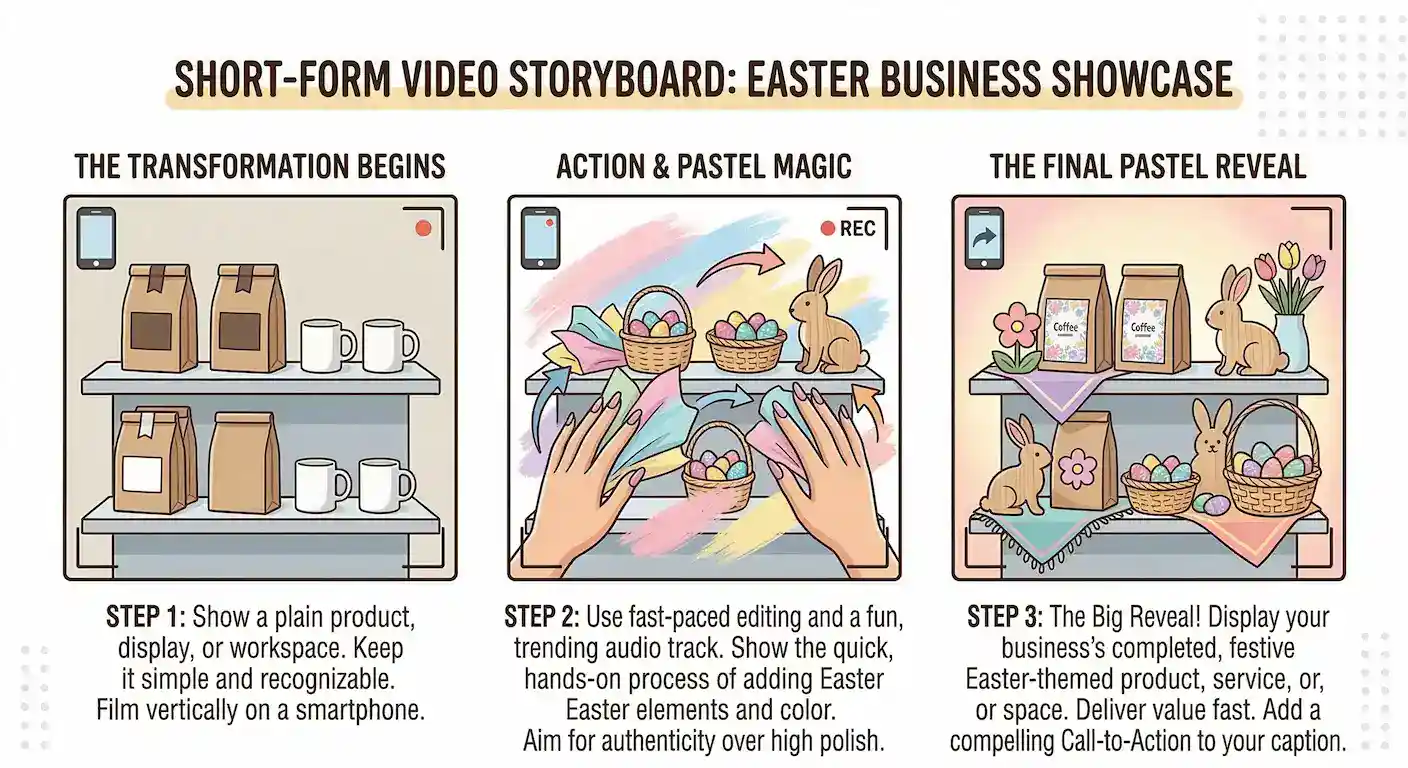
- Transformation videos: Show a plain product, workspace, or table setting turned into an Easter-themed version. The visual payoff is quick and easy to understand.
- Trending audio adaptations: Pair popular audio with Easter-themed footage to increase discoverability without building a concept from scratch.
- Process and tutorial content: Quick recipes, craft ideas, or styling tips perform well because they deliver value fast and encourage saves.
- Team and culture moments: Behind-the-scenes clips of your team preparing for Easter help humanize your brand in a format that feels native to TikTok and Reels.
Branded augmented reality (AR) filters on TikTok and Instagram can also extend reach. A simple Easter-themed filter (bunny ears, egg overlays, or pastel color grading) invites participation and can support playful campaigns like virtual egg hunts.
The practical rule for short-form Easter video is simple: prioritize speed over polish. A timely, authentic 20-second Reel filmed on a smartphone will often outperform a heavily produced video that arrives too late. Shoot quickly, edit simply, and post while the holiday is still approaching.
Quick Launch Checklist: Your 2-Week Easter Social Media Execution Plan
Knowing what to do is one thing. Knowing when to do it, and in what order, is what separates a campaign that builds momentum from one that stalls before it starts.
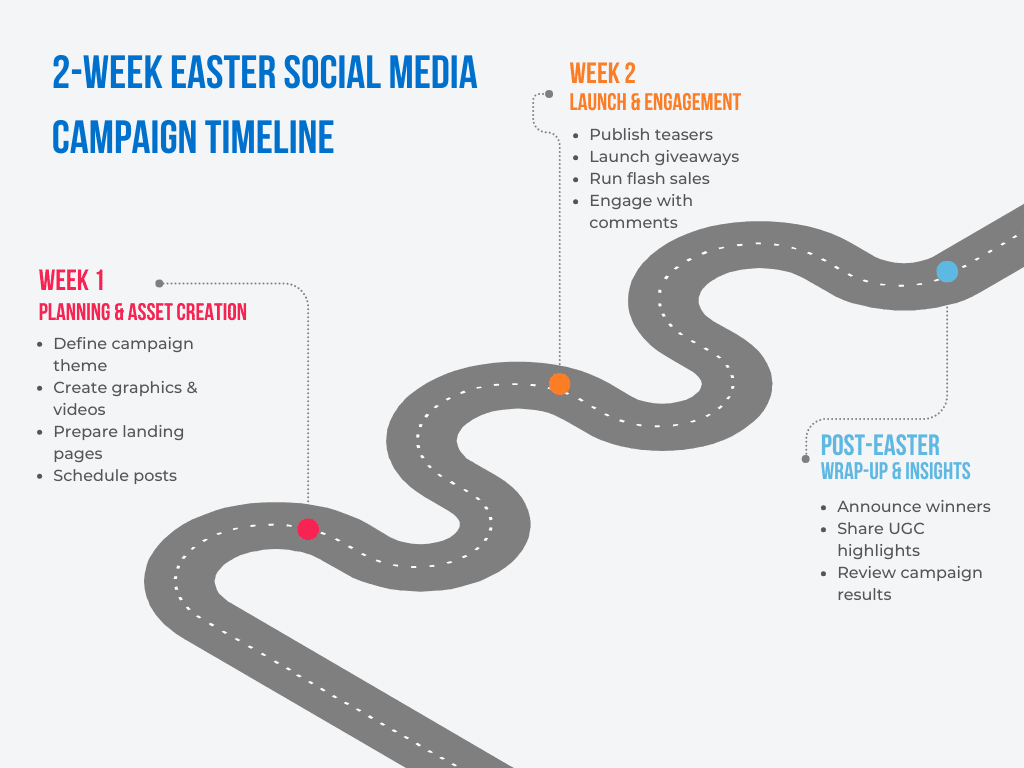
The two-week Easter execution plan below is designed to remove the guesswork. It divides your available time into two distinct phases: planning and asset creation, followed by scheduling, publishing, and optimization.
Each phase has a clear purpose, and each day has a defined focus.
Think of it the way a retail operation approaches a seasonal window display. Preparation happens before the store opens.
When customers arrive, everything is already in place, intentional, and ready to perform. Your campaign works the same.
For a quick overview, use the checklist below before diving into the day-by-day breakdown:
| Days | Focus | What to Do | Deliverable / Outcome |
| 1–3 | Strategy and foundation | Define your Easter theme, set SMART goals, identify your audience, and audit existing content you can repurpose. | Clear campaign angle, goals, audience, and content gap list |
| 4–5 | Asset creation | Design spring-themed graphics, record short-form video, and draft captions. If using creators, confirm briefs and posting dates. | Content assets ready to publish |
| 6–7 | Technical setup and scheduling | Finalize landing pages, promo codes, countdowns, giveaway setup, and post scheduling. | Campaign infrastructure ready and scheduled |
| 8–10 | Teasers and launch | Publish teaser posts, behind-the-scenes content, bundle previews, and countdowns. Start paid support or boosted posts. | Campaign goes live and builds anticipation |
| 11–12 | Interactive push | Launch UGC, giveaways, polls, quizzes, or “Crack the Egg” Stories. Monitor comments and DMs. | Engagement and participation increase |
| 13–14 | Final conversion push | Post last-call reminders, final countdowns, giveaway deadlines, shipping cutoffs, and urgent offer messaging. | Strong final sales and conversion push |
| Post-Easter | Follow-up | Announce winners, share standout UGC, send prizes or codes, and note what performed best. | Campaign wrapped and insights captured |
Get the 2-Week Easter Social Media Checklist
Want the plan in a format you can actually use? Download the step-by-step Easter checklist to map content, launch faster, and keep your campaign on track.
Week One: Planning, Content Creation, And Campaign Setup (Days 1–7)
The first week is entirely about building the infrastructure of your campaign before a single post goes live. Rushing this phase is the most common reason campaigns feel generic or disconnected, and it’s entirely avoidable with a clear daily structure.

Days 1–3: Strategy and Foundation
Begin by defining your central Easter theme and establishing SMART goals (Specific, Measurable, Achievable, Relevant, and Time-bound). Clarity here shapes every decision that follows.
Ask yourself:
- Are you focused on driving traffic to a landing page?
- Are you looking to grow your follower count?
- Are you converting warm audiences with a limited-time offer?
Identify your target audience for this specific campaign, which may be a subset of your broader customer base. A gift-focused Easter campaign, for example, might target a different demographic than your standard product promotions.
Alongside goal-setting, audit your existing content library. Many businesses find that repurposing existing product photography with a seasonal color overlay or caption refresh is faster and more cost-effective than producing entirely new assets.
Identify what can be adapted, and flag only the gaps that require original creation.
Days 4–5: Asset Creation
This is your production window. Use this focused time to:
- Design spring-themed graphics using your established pastel palette
- Record any short-form video content
- Draft caption copy for every planned post
Batch-producing your assets in a single session, rather than creating content day by day, dramatically reduces the mental overhead of running a campaign while also managing your business.
If you’re working with a micro-influencer, confirm posting dates and ensure they have received their product brief and any required assets by Day 4 at the latest.
Days 6–7: Technical Setup and Scheduling
Technical elements should be finalized and tested by Day 6. This includes:
- Promotional landing pages
- Discount codes
- Virtual Easter egg hunt configurations
- Countdown stickers
All primary campaign posts should be loaded into a social media scheduling tool by Day 7; at least one week before the holiday. This buffer is a safeguard.
Scheduled content ensures consistent delivery even when your attention is pulled toward real-time campaign management, customer inquiries, or operational demands.
Week Two: Publishing, Engaging, And Optimizing In Real Time (Days 8–14)
Week Two is where your preparation pays off.
The campaign is live, your audience is responding, and your role shifts from creator to manager. This phase requires active attention, not frantic content creation, because that work is already done.
Days 8–10: Teaser Content and Campaign Launch
Begin publishing teaser content across your platforms to build audience anticipation before your main campaign elements go live. A teaser might be:
- A partial reveal of your Easter bundle
- A behind-the-scenes clip of your team preparing for the holiday
- A simple countdown post that signals something is coming
Teasers serve a practical function: they prime your audience to expect and look for your content, which improves the performance of your main campaign posts when they arrive.
Activate any paid advertising campaigns or boosted posts during this window. Paid amplification in the days leading up to the holiday weekend maximizes visibility when consumer intent is at its highest.
Even a modest daily budget applied to your top-performing organic post can meaningfully extend your reach without requiring a full paid media strategy.
Days 11–12: Interactive Campaign Elements
These are the optimal days for launching your interactive campaign elements.
Consider:
- User-generated content (UGC) contests
- Giveaways
- Easter-themed polls
- “Crack the Egg” flash sale reveals on Stories
Launching interactive content mid-week gives your audience time to participate and share before the holiday arrives, sustaining momentum through the final days of the campaign.
Monitor participation closely and respond to comments, entries, and direct messages promptly. Audience responsiveness during an active campaign is a direct signal of brand attentiveness, and it influences whether participants share your content with their own networks.
Days 13–14: Urgency and Final Conversion Push
The final two days of your campaign window are reserved for urgent, last-minute reminders and countdown content. Keep the messaging direct, the visual treatment consistent with your campaign aesthetic, and the call to action unambiguous.
Effective last-push content includes:
- A final reminder that your Easter bundle expires at midnight
- A last-call notification for your giveaway
- A countdown sticker on your Stories pointing to your limited-time offer
Research indicates that over 40% of consumers make impulse purchases when an offer is framed as temporary. This final push is not a courtesy reminder; it’s a conversion mechanism.
Post-Easter Follow-Up
The campaign doesn’t end on Easter Sunday. The day or two following the holiday is an important operational window.
Use this time to:
- Announce contest winners publicly
- Share standout user-generated content with proper attribution
- Send any promised discount codes or prizes promptly
This follow-up reinforces trust, rewards participation, and sets a positive precedent for future campaigns. It also provides the raw material for your post-campaign analysis (which posts drove the most traffic, which offers converted, and which formats you’ll prioritize next season).
Platform-Specific Daily Actions To Keep Momentum Going
Maintaining consistent activity across platforms during a two-week campaign doesn’t require posting everywhere every day. It requires posting the right content type on the right platform at the right frequency. Here’s a practical framework:
- Instagram: Post one feed post or Reel every two days, and use Stories daily for interactive elements, like polls, countdown stickers, behind-the-scenes clips, and flash sale reveals.
- Facebook: Post three to four times per week, prioritizing content that invites comments and shares, like giveaway announcements, tutorial videos, and community-oriented Easter content.
- TikTok: Post daily or every other day during the campaign window, leaning into trending audio and short-form tutorial formats.
- Pinterest: Schedule Easter-themed pins beginning in Week One, as Pinterest content has a longer discovery tail than other platforms. Product imagery, recipe tutorials, and seasonal styling guides perform particularly well.
How does this compare to your current platform posting habits? Even small adjustments to frequency and format can produce a measurable difference in reach and response.
Tools And Templates That Speed Up Your Two-Week Turnaround
The right tools save time and reduce the decision fatigue that slows down small teams and marketers during high-pressure campaign windows. Several accessible platforms can meaningfully accelerate your two-week execution.
Here’s a quick reference by use case:
| Use Case | Recommended Tools |
|---|---|
| Graphic design | Canva (Easter-specific templates adaptable to your brand palette) |
| Content scheduling | Later, Buffer, or Meta’s native scheduling feature |
| Contest and giveaway management | Gleam or Woobox |
| Caption drafting and copy variations | AI writing tools for generating multiple caption options from a single brief |
For caption drafting, for example, AI writing tools can help you test different angles, from urgency-driven to community-focused, without spending hours on copy. The goal is not to replace your brand voice, but to reduce the blank-page friction that slows production when time is limited.
Even a short setup session in Week One can save hours in Week Two, freeing you up to respond to UGC entries, answer customer questions, and adjust your campaign in real time.
Paid Social Strategy & Tactical Tips For Easter Campaigns
Organic content builds community, but paid social expands your reach beyond existing followers. For short Easter campaigns, paid ads help place your offer in front of people who are already in a buying mindset.
A focused Easter ad campaign doesn’t require a large budget. What matters most is a clear objective, strong creative, and targeting that connects your offer with the right audience.
How To Structure Your Easter Ad Creative For Maximum Click-Through
Ad creative is the first interaction between your campaign and potential customers. It should communicate your offer clearly and capture attention within the first few seconds.
For Easter campaigns, seasonal visuals such as pastel colors, spring imagery, and holiday themes signal relevance immediately. However, visuals alone are not enough.
The most effective ads combine:
- A clear value proposition
- A time-sensitive hook
- A direct call to action
Urgency-driven messaging like “Offer ends Easter Sunday” or “Available this week only” can significantly increase conversion rates during a short campaign window.
A/B testing is also essential for improving performance. Test at least two creative variations, such as:
- Lifestyle imagery that shows your product in use
- Product-focused visuals with a clear promotional overlay
Even small creative changes can impact click-through rates.
Gamified ad formats, such as scratch cards, quizzes, or reveal mechanics, can also improve engagement and reduce cost per lead compared to static ads.
Audience Targeting Tactics: Reaching Shoppers Who Are Already In Buying Mode
Effective targeting separates an ad that reaches the right person at the right moment from one that generates impressions without intent.
Start with warm audiences such as:
- Existing customers who already trust your brand
- Website visitors who have shown purchase intent
- Social media followers who are familiar with your products
These groups already know your brand and typically respond well to seasonal offers.
Beyond warm audiences, consider broader interest-based targeting. Many people who don’t formally celebrate Easter still purchase seasonal products, gifts, and spring-related items.
Target interests such as:
- Spring entertaining
- Seasonal cooking
- Gift ideas
- Family activities
This approach helps your campaign reach purchase-ready audiences beyond traditional holiday shoppers.
Retargeting Warm Audiences With Easter-Specific Offers And Urgency Messaging
Retargeting is one of the most effective tactics for short campaign windows.
Users who have visited your website or engaged with your content already show interest in your brand. They don’t need to be introduced to you. They need a reason to act now.
Easter-specific retargeting ads should be distinct from your general retargeting creative. Use seasonal visuals, reference the limited-time nature of your offer explicitly, and tailor the messaging to where the viewer is in their decision process.
Here’s why this matters: someone who visited your product page but didn’t purchase is closer to conversion than someone who simply liked a post.
Segment your audiences based on behavior:
- Product page visitors → Direct offer with urgency
- Post or video viewers → Brand-focused seasonal messaging
- Past customers → Exclusive bundle or loyalty offer
Limited-time Easter bundles work particularly well for retargeting because they combine familiarity, exclusivity, and urgency.
Budget Allocation Tips For Short-Window Holiday Campaigns
Short seasonal campaigns require concentrated spending.
Launching ads early in the two-week window helps capture early shoppers and avoids the higher advertising costs closer to the holiday.
Starting early also gives your campaigns time to exit the platform’s learning phase (the initial period during which algorithms optimize delivery) before your peak conversion window arrives.
A practical budget structure for a two-week Easter campaign:
| Week | Budget Allocation | Primary Objective |
|---|---|---|
| Week 1 | ~40% of budget | Awareness and audience building |
| Week 2 | ~60% of budget | Conversion and retargeting |
This approach mirrors the logic of a well-managed retail promotion: build awareness first, then concentrate your conversion effort when your audience is most prepared to act.
Mobile optimization is also essential. Since nearly 60% ecommerce traffic now comes from mobile devices, ensure your ads, landing pages, and checkout experience work seamlessly on smaller screens.
Platform-By-Platform Paid Social Recommendations (Instagram, Facebook, TikTok, Pinterest)
Each platform has its own advertising strengths, audience behaviors, and creative requirements. A one-size-fits-all approach to paid content rarely performs as well as a platform-native creative piece that respects how users consume content in each environment.
- Instagram: Ideal for visual product content, Reels ads, and retargeting warm audiences.
- Facebook: Strong for detailed targeting, giveaways, and carousel ads showcasing product bundles.
- TikTok: Best for short-form video, tutorials, and creator-style content that feels native to the platform.
- Pinterest: Highly effective for seasonal discovery. Promoted pins featuring products, tutorials, or gift ideas can drive traffic even after the holiday.
Throughout your two-week window, monitor these key performance indicators across all platforms:
- Cost per conversion
- Returning profile visits
- Interaction rates on interactive content
Monitoring these metrics allows you to shift budget toward the ads and placements generating the strongest results.
Measurement & KPIs For Easter Social Campaigns
Running a well-structured Easter campaign is only half the equation. The other half is knowing whether it actually worked and why.
Tracking the right metrics during and after your Easter campaign transforms it from a one-time effort into a repeatable, increasingly effective seasonal strategy.
The good news is that you don’t need a complex analytics setup to measure campaign performance meaningfully. Most of what you need is already available through native platform tools and a few straightforward tracking practices.
Let’s explore how to approach measurement in a way that’s practical, actionable, and genuinely useful for your business.
Defining Clear Goals Before You Hit Publish
Measurement starts before your first post goes live. Without a defined goal, there’s no standard against which to evaluate your results. Before launching any Easter campaign content, decide which of the three primary objectives you’re optimizing for:
- Awareness: Expand your reach by introducing your brand to new audiences during a high-traffic seasonal moment.
- Engagement: Prioritize interaction, encouraging your existing audience to participate, share, and connect with your content.
- Conversion: Drive a specific action: a purchase, a sign-up, a website visit, or a discount code redemption.
The important discipline is assigning a primary goal to each campaign element. That way, you’re measuring the right outcomes for each piece, not applying a single metric across everything and drawing inaccurate conclusions.
Key Metrics To Track: Engagement Rate, Reach, Participation, And Conversion
Once your goals are defined, the most important social media metrics you track should map directly to those objectives. Here’s a focused view of the essential KPIs most relevant to Easter social campaigns:
- Engagement rate measures how actively people interact with your content relative to your reach. High reach with low engagement often signals that the content was seen but didn’t resonate with the audience.
- Click-through rate (CTR) shows how effectively your content drives viewers to take the next step, such as visiting a landing page, exploring a product, or redeeming an offer.
- Conversion rate measures the percentage of users who completed the desired action after clicking. When paired with CTR, it reveals whether your landing page or offer successfully turned interest into action.
- Participation metrics apply to interactive Easter content like digital egg hunts, quizzes, or “Crack the Egg” Stories. Track participation numbers and story completion rates to understand how deeply audiences engage with the experience.
- Reach and impressions remain important baseline metrics. Reach counts unique accounts that saw your content, while impressions include total views; reach is typically the better indicator of new audience exposure.
For video content (Instagram Reels, TikToks, YouTube Shorts) dwell time and watch time are essential metrics. They reveal how much of your content your audience is actually consuming.
A high view count paired with low average watch time suggests viewers are dropping off early, which points to a clear need: front-load your most compelling content in the first few seconds.
How To Measure UGC Campaign Success And Community Growth
User-generated content (UGC) campaigns introduce additional metrics beyond standard post analytics. Branded hashtag contests or shared Easter moments reveal not just content performance but the level of community participation around your campaign.
Key indicators of UGC campaign success include:
- Total submission volume using your branded hashtag
- Reach generated by participant posts — exposure driven by your audience, not your ad budget
- New follower growth during the campaign window
Follower growth is a particularly useful signal here. A well-executed UGC campaign that reaches new audiences through participant sharing should produce a measurable uptick in followers.
Sentiment is another useful indicator. Reviewing captions and audience responses can reveal how people actually talk about your brand, offering insights that standard analytics cannot capture.
Many businesses find that UGC campaigns surface authentic customer language that can inform future ad copy, product descriptions, and content strategy. That’s a compounding return on a single campaign effort.
To measure the direct revenue impact of your Easter campaign, assign unique promo codes to different social media channels or campaign elements. For example, a code tied to your Instagram Stories lets you attribute sales directly to that placement.
This approach removes guesswork from your ROI calculation and gives you channel-level performance data that informs future budget decisions.
A/B Testing Your Easter Content For Higher Performance
A/B testing is one of the most reliable tools available for improving campaign performance in real time. Even simple tests can improve click-through rates, conversions, and overall campaign efficiency. The key to effective A/B testing within a short campaign window is focus.
Test one variable at a time:
- The headline
- The visual treatment
- The call-to-action phrase
- The offer framing
Testing multiple variables simultaneously makes it difficult to determine which change drove the performance difference.
Start with the element most likely to influence your primary KPI. For conversion campaigns, that’s typically the call-to-action or the offer presentation; for engagement campaigns, it’s usually the visual or the opening line of the caption.
A/B testing also works for organic content. For example, comparing two versions of an Easter graphic (product-focused vs lifestyle imagery) can reveal which approach drives higher engagement.
Over time, these incremental improvements compound into a significantly stronger content strategy.
Post-Campaign Reporting: What To Analyze And How To Apply It Next Season
The period immediately after Easter is when campaign data is freshest and most useful for analysis. A structured post-campaign review, even a brief one, extracts the insights that make your next seasonal campaign measurably better.
Start with your financial metrics.
Return on investment (ROI) and return on ad spend (ROAS) are the headline figures that tell you whether the campaign generated more value than it cost.
Calculate these at the campaign level and, where possible, at the individual channel or ad set level. This granularity reveals which platforms and placements delivered the strongest financial return: information that directly informs your budget allocation for future campaigns.
Next, review your traffic data.
UTM parameters (tags added to URLs that identify traffic source and campaign) allow you to accurately attribute website visits, sign-ups, and purchases to specific social media posts or ads.
If you haven’t used UTM parameters in previous campaigns, implementing them for Easter is a straightforward step that dramatically improves the accuracy of your attribution data. Most analytics platforms, including Google Analytics, process UTM data automatically and present it in a clear channel-by-channel breakdown.
As a final step, document what worked and what didn’t
Not just in terms of numbers, but in terms of content approach, timing, and audience response. A few questions worth answering while the campaign is still fresh:
- Which post format generated the most saves?
- Which ad creative had the lowest cost per conversion?
- Which day of the two-week window produced the highest engagement?
These observations become the strategic foundation for a stronger Easter campaign next year. The goal isn’t perfection on the first attempt; it’s a consistent improvement cycle that builds campaign intelligence over time.
Want a Custom Easter Campaign Plan?
If you want help turning these ideas into a campaign that is planned, launched, and optimized around your goals, we can put together a custom proposal for your brand.
Frequently Asked Questions
Conclusion
Two weeks is not a constraint; it’s a focused window of opportunity.
The brands that perform best during Easter are rarely the ones with the biggest budgets or the most elaborate production plans. They’re the ones that move with clarity and intention, connecting with their audience in ways that feel timely, relevant, and genuinely worth their attention.
A strong Easter social media strategy doesn’t require doing everything at once. It requires doing the right things well. Here’s a quick recap of the essential pillars covered in this guide:
- Interactive contests that build community momentum quickly
- Gamification tactics that deepen audience participation and time-on-platform
- Urgency-driven content that motivates immediate purchasing decisions
- Visual storytelling that earns attention in a crowded feed
- Targeted paid social that extends your reach within a compressed timeline
- A measurement framework that tells you what’s actually working and what to adjust
Each of these pillars can stand on its own. That’s an important point for any business working with limited time or resources.
You don’t need to execute every idea here. Research consistently shows that one or two well-planned tactics yield stronger results than a delayed, overly complex campaign.
The structured two-week checklist is designed to help you prioritize, sequence, and execute without second-guessing every decision. Use it.
Here’s why this matters right now: Last-minute Easter shoppers represent a significant segment of holiday retail consumers. They are actively looking for brands that show up with relevant offers and clear calls to action. Every day without a visible presence is a day that the audience may be discovering a competitor instead.
How does your current approach compare? If you’re still weighing options, consider this a practical nudge.
Pick one idea. Launch it today. Refine as you go.
Your Easter campaign doesn’t need to be perfect; it needs to be present.
If your team wants to launch a high-impact Easter social media campaign quickly, partnering with a social media marketing agency can streamline strategy, content production, and cross-platform campaign execution.