
There’s no denying that Instagram has changed how people share and discover content online. What began as a simple photo-sharing app in 2010 has grown into one of the world’s largest social platforms — expanding far beyond the original “filtered photo” feed into Stories, short-form video, messaging, and shopping. In this guide, we’ll look back at Instagram’s biggest turning points and explain how those changes reshaped social media behavior, marketing, and everyday culture along the way.
How Instagram Has Changed Over Time: Evolution Since Launch
Instagram’s journey from a simple photo-sharing app to a global social media powerhouse represents one of the most remarkable evolutions in digital history. When Kevin Systrom and Mike Krieger launched Instagram in October 2010, it was exclusively available on iOS and focused solely on allowing users to share filtered photos.
The app’s initial success was impressive, gaining one million users within just two months of launch, but few could have predicted its meteoric rise to become one of the world’s most influential social platforms.
The evolution of Instagram can be traced through several transformative milestones. In April 2012, Facebook acquired Instagram for approximately $1 billion, a move that provided the resources needed for rapid expansion. By 2013, Instagram introduced video sharing capabilities, allowing users to share 15-second clips, which later expanded to 60 seconds in 2016.
This marked the platform’s first significant departure from being exclusively photo-focused, setting the stage for its multimedia future. The introduction of Instagram Direct in late 2013 added private messaging functionality, transforming the platform from a broadcasting tool to a comprehensive communication channel.
Perhaps the most significant evolutionary leap came in August 2016 with the introduction of Instagram Stories, a feature directly inspired by Snapchat that allowed users to share ephemeral content that disappeared after 24 hours. This feature dramatically changed user behavior on the platform, encouraging more frequent, casual sharing and increasing daily engagement.
The Stories format proved so successful that it was subsequently adopted by other social platforms, cementing Instagram’s role as an innovator in the social media landscape. By 2018, Instagram had launched IGTV for longer-form vertical videos, further diversifying its content offerings.
The platform’s business features have evolved in parallel with its consumer-facing tools. Instagram gradually introduced advertising options, shopping features, and creator monetization tools, transforming from a purely social platform to a powerful e-commerce and marketing ecosystem.
The introduction of Instagram Reels in 2020 as a response to TikTok’s growing popularity demonstrated the platform’s continued ability to adapt to changing user preferences and competitive threats. Throughout these changes, Instagram has maintained its visual-first approach while expanding its functionality to encompass virtually every type of social media interaction, from ephemeral content to long-form videos, from private messaging to public broadcasting, and from personal expression to commercial transactions.
Key Milestones in Instagram’s Development
Instagram’s evolution can be marked by several key developments that fundamentally changed how users interact with the platform. The introduction of the Explore page in 2012 transformed content discovery, allowing users to find photos and accounts beyond their immediate network.
This feature has undergone numerous refinements over the years, becoming increasingly sophisticated in its ability to match users with content that aligns with their interests, significantly expanding the potential reach for creators.
The algorithmic feed, introduced in 2016 to replace chronological posting, represented another pivotal shift in how content is consumed on the platform. This change prioritized relevance over recency, using machine learning to determine which posts users were most likely to engage with.
Despite initial user resistance, this algorithmic approach has become a cornerstone of Instagram’s content distribution strategy, continuously evolving to incorporate more signals and better predict user preferences.
Instagram’s business tools have seen substantial evolution as well. What began as basic sponsored posts has developed into a comprehensive suite of advertising options with sophisticated targeting capabilities.
The introduction of business profiles in 2016, followed by creator accounts in 2019, provided specialized tools for different types of professional users. Shopping features, which began rolling out in 2016 and expanded significantly in 2020 with dedicated Shop tabs, transformed Instagram into a major e-commerce platform where users could discover and purchase products without leaving the app.
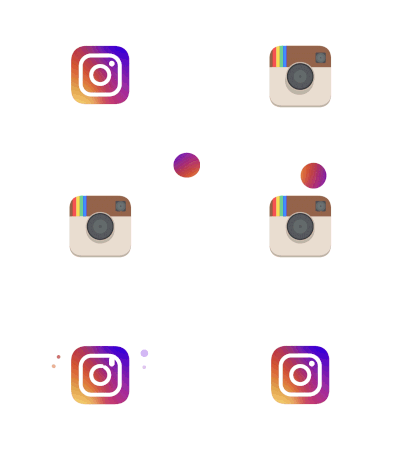
The evolution of Instagram’s interface and design philosophy has been equally significant, though perhaps less obvious to casual observers. The app has gradually moved from its initial skeuomorphic design elements (like the realistic camera icon) to a cleaner, more minimalist aesthetic.
Navigation has been repeatedly reorganized to accommodate new features while maintaining usability, with the most recent major redesign in 2020 placing Reels and Shop tabs prominently in the main navigation bar—a clear indication of the company’s strategic priorities.
How and Why Instagram Became Popular: The Full Story
Instagram became popular fast because it launched at the right moment for smartphones — and made everyday photos look “share-worthy” with almost no effort. The app debuted on iPhone on October 6, 2010, and quickly hit early traction: about 25,000 users on day one and roughly 1 million users within its first few months.
The next major growth jump came in April 2012 when Instagram launched on Android (opening access to a much larger global device market) and Facebook announced its plan to acquire Instagram for approximately $1 billion. From there, Instagram’s popularity moved from “hot app” to mainstream platform: it reached 100 million monthly users in early 2013 and kept expanding as new formats arrived — video (2013), Direct messages (2013), and especially Stories (2016), which made posting feel more casual and frequent.
By June 2018, Instagram announced 1 billion monthly active users — a milestone that confirmed it was no longer just a photo app, but a dominant social network. More recently, Meta has said Instagram has surpassed 3 billion monthly active users, reflecting how Reels, messaging, and creator tools have widened the platform’s role in everyday internet culture.
Why it took off comes down to a few repeatable drivers: mobile-first design, simple creation tools, strong discovery via hashtags/Explore, celebrity and brand adoption, and constant feature evolution that kept Instagram competitive as social media habits changed.
Instagram’s Technical Evolution
Behind the scenes, Instagram’s technical infrastructure has undergone massive evolution to support its growing user base and expanding feature set. The platform has had to solve complex engineering challenges related to content delivery, storage efficiency, and real-time processing at enormous scale.
Instagram’s engineering team has published numerous case studies detailing how they’ve addressed these challenges, from optimizing image compression algorithms to building sophisticated recommendation systems.
The shift from a monolithic architecture to microservices has enabled more rapid development and deployment of new features. Similarly, Instagram’s adoption of React Native for its mobile applications has allowed for more efficient cross-platform development. The platform’s machine learning capabilities have evolved dramatically, powering everything from content recommendations to automated content moderation systems that help maintain community standards across billions of posts.
Data analytics capabilities have also evolved significantly, providing both Instagram’s internal teams and external business users with increasingly sophisticated insights into content performance and user behavior. These technical advancements, while invisible to most users, have been crucial in enabling Instagram’s product evolution and maintaining performance despite exponential growth in users and content volume.
Instagram’s Impact on Society, Culture, and Everyday Life
As a visual-first platform with billions of monthly users worldwide, Instagram has influenced everything from language and social norms to business models and career paths. The platform’s emphasis on visual storytelling has elevated photography and videography into everyday communication tools, democratizing content creation and blurring the lines between professional and amateur creators.
This shift has created a visual-centric culture where moments are increasingly experienced through the lens of “shareability,” with many users consciously curating experiences based on their Instagram potential.
The rise of Instagram has redefined influence and celebrity in the digital age. The platform gave birth to the “influencer” as a mainstream career path, creating new power dynamics in marketing and media. These digital creators have disrupted traditional gatekeepers in industries ranging from fashion and beauty to travel and food, establishing direct relationships with audiences and brands.
This democratization of influence has positive aspects, giving voice to previously underrepresented groups and perspectives, but has also created new hierarchies based on metrics like follower counts and engagement rates. The influencer economy built around Instagram has grown into a multi-billion dollar industry that has forced traditional advertising and media companies to adapt their strategies and business models.
Perhaps most significantly, Instagram has impacted how individuals—particularly younger generations—form and express their identities. The platform serves as a space for self-presentation and identity construction, where users carefully curate representations of themselves for public consumption. This has created both opportunities for creative self-expression and challenges related to authenticity and self-image.
Studies have linked Instagram use to increased social comparison, with users frequently measuring their lives, appearances, and achievements against the highlight reels of others. This phenomenon has contributed to concerns about the platform’s impact on mental health, body image, and self-esteem, particularly among adolescents and young adults who are in critical stages of identity development.
The cultural impact of Instagram extends to language and communication norms, with the platform popularizing visual-centric communication styles and spawning new terminology that has entered mainstream vocabulary. Terms like “Instagram aesthetic,” “grid,” and “Stories” have become common parlance, while practices like “doing it for the gram” reflect how the platform has influenced behavior.
Instagram has also shaped travel and consumption patterns, with businesses and destinations increasingly designed to be “Instagrammable.” This has created economic opportunities in many sectors but has also led to concerns about overtourism in photogenic locations and the homogenization of design aesthetics across restaurants, hotels, and public spaces worldwide.
Instagram and Social Relationships
Instagram has fundamentally altered how we form, maintain, and navigate social relationships in the digital age. The platform functions as a social utility that enables connections across geographic and social boundaries, allowing users to maintain ambient awareness of friends, family, and acquaintances through passive consumption of their visual updates.
This has created new forms of “lightweight” social connection that complement traditional relationships but also raise questions about depth and authenticity in digital interactions.
The public nature of Instagram interactions—through likes, comments, and follows—has created new social currencies and status indicators. These visible metrics have introduced complex social dynamics where public affirmation becomes quantifiable and comparable. For adolescents in particular, these dynamics can significantly impact social hierarchies and sense of belonging.
The platform’s role in romantic relationships is equally significant, with “Instagram official” becoming a recognized relationship milestone and profile activity often scrutinized for relationship insights.
Community formation represents one of Instagram’s more positive social impacts, with the platform enabling connections between people with shared interests, experiences, or identities regardless of geographic proximity. Niche communities ranging from rare plant enthusiasts to chronic illness support groups have flourished on Instagram, providing valuable social support and information exchange.
These communities often develop their own norms, language, and practices, creating meaningful social bonds that can translate into real-world connections and movements. However, the platform’s algorithmic curation can also create filter bubbles that limit exposure to diverse perspectives, potentially reinforcing existing beliefs and contributing to social polarization.
Instagram’s impact on social norms around privacy represents another significant societal shift. The platform has normalized sharing previously private aspects of life—from meals and workouts to intimate family moments—with broad audiences. This has created new expectations around disclosure and accessibility that vary significantly across generations. For many younger users who have grown up with the platform, the boundaries between public and private life are more fluid than for previous generations, representing a fundamental shift in social norms around privacy and self-disclosure.
How Instagram Has Affected Mental Health: What the Research Shows
Instagram’s mental health impact isn’t one-size-fits-all. Research and reporting consistently show that outcomes depend on who is using the platform, what they see, and whether they’re actively creating/connecting or mostly scrolling and comparing.
Where harms show up most often is social comparison: highly curated photos, beauty filters, and “highlight reel” posts can intensify body dissatisfaction and self-criticism — especially for teens and young adults. In public reporting on Meta’s internal research, one recurring finding was that a meaningful share of teen girls said Instagram made them feel worse about their bodies when they were already struggling.
Independent research also suggests that time and usage patterns matter. Studies that limit daily social media use have found improvements in well-being measures like loneliness and depressive symptoms, which supports a practical takeaway: reducing passive scrolling can help.
At the same time, Instagram can benefit mental health when it’s used for genuine connection. Support communities (for health conditions, identity groups, hobbies, or recovery journeys) can reduce isolation, and creative posting can reinforce self-expression and belonging.
In response to these concerns, Instagram has added features meant to reduce pressure and overuse — including optional hidden like counts and “Take a Break” prompts. The most useful guideline for readers is simple: if Instagram leaves you feeling worse, shift toward active engagement (creating, messaging, community) and set time boundaries that reduce passive comparison.
Instagram’s Economic and Political Influence
Instagram’s economic impact extends far beyond the influencer marketing ecosystem, reshaping business models across multiple industries. The platform has become an essential marketing channel for businesses of all sizes, with its visual nature proving particularly valuable for industries like fashion, beauty, food, and travel.
Small businesses have leveraged Instagram to reach customers without traditional advertising budgets, effectively democratizing access to marketing channels previously dominated by larger companies with substantial resources.
The “Instagram effect” on product development and retail strategy has been profound, with businesses increasingly designing products and experiences with “Instagrammability” as a primary consideration. This has led to the rise of experiential retail, pop-up installations specifically designed for social media sharing, and product packaging optimized for visual appeal on the platform.
Entire business categories—from photo-friendly dessert shops to interactive museums—have emerged or expanded largely due to their Instagram potential, demonstrating the platform’s power to drive consumer behavior and business innovation.
In the political sphere, Instagram has emerged as an increasingly important platform for civic engagement and political communication. Political figures use the platform to humanize their image and connect directly with constituents, particularly younger voters who may be less engaged with traditional media channels. Social movements have leveraged Instagram’s visual storytelling capabilities to raise awareness and mobilize support, with hashtags and shareable graphics becoming powerful tools for advocacy.
The Black Lives Matter movement, climate activism, and various human rights causes have all used Instagram effectively to amplify their messages and organize communities around shared values and goals.
Instagram’s role in shaping public discourse extends to its influence on news consumption patterns, particularly among younger users who increasingly encounter news content through the platform rather than traditional news sources. This shift has created both opportunities for more engaging, accessible news formats and challenges related to context, depth, and misinformation.
The platform’s visual nature can make complex issues more immediately understandable but can also oversimplify nuanced topics. As Instagram continues to evolve its features and policies, its influence on economic systems and political processes will likely continue to expand, raising important questions about platform responsibility and the governance of digital public spaces.
Frequently Asked Questions About Instagram’s Impact

Tailored Social Media Proposal
That Drives Results.
3, 2, 1 TAKEOFF INSTAGRAM!
In October 2010, Instagram launched as a mobile photo-sharing app built around filtered images and a simple feed. In April 2012, Facebook announced it would acquire Instagram for approximately $1 billion — a deal that drew attention because Instagram was still early in building its business model. Over time, Instagram became a major advertising platform through sponsored content and advanced targeting, and it later expanded into creator tools and shopping features that made it valuable not just for users, but also for brands and businesses.
DO IT FOR THE ‘GRAM
Remember when you could take a picture of your bed and add a simple caption like “my favorite hello and hardest goodbye”? Or when you snapped a quick selfie with your best friend and slapped it on Instagram before you jumped in the pool? Man, those were the days…
BUT…..Instagram, my friend, you have completely changed the game.
Let’s take a moment to go over the unsaid rules of Instagram:
– The caption must be powerful and engrossing
– Instagram pictures need perfect to be edited, but watch out not TOO much or you’ll be judged
– Your feed needs to have a cohesive filter or fit a theme
– The bio needs to be appeal to your potential followers
– You need to wait until the perfect time to post the pictures to ensure an ideal number of likes

We could talk about these “rules” for hours. These don’t even touch on the apps created just for Instagrammers’ success… When did Instagram become a formulated process? Can we just go back to the simple selfies and pictures of our mocha lattes?
So what happens if you choose not to conform to Instagram’s unsaid “rules”? No likes and no new followers. Plus, with the new algorithm, you aren’t even guaranteed a spot on your best friends’ feeds.
But, chances are that if you’ve fallen into the Instagram way of life, it’s hard to let your hair down when it comes to other social channels as well. It’s almost like you’ve got to keep up your online reputation. I mean, we can’t let the followers down, right?

CONVERT MORE VISITORS INTO REVENUE, BOOST YOUR COMPANY’S GROWTH WITH SOCIAL MEDIA!
TAKING CHARGE ~ONE FEATURE AT A TIME~
Over the past few years, Instagram has become the game-changing social media app. The app is constantly releasing new features that set it apart from the other social media platforms. The ingenuity has caused other social media platforms to seem inferior. They are constantly having to play catch up or change their image and evolve to Instagram standards.
- Filters
- Nowadays, most social media platforms have filter options for photographs. But, Instagram started this trend and they remain the leader in filters and editing functionalities.
- Boomerang
- In 2015, Instagram launched Boomerang. This feature takes a burst of photos and meshes them together into a little video that plays forward and backwards. This feature creates a fun and unique video.
- Focus
- In 2018, Instagram introduced Focus, a portrait-style camera mode that blurs the background to make the subject stand out. It appears alongside other camera options in the Stories camera and gives creators a quick way to get a “portrait mode” look without leaving the app.
- Instagram Stories
- Okay Snapchat, we’ll give you credit for the innovative idea behind stories, but you can’t deny that Instagram has taken the idea and perfected it. If you are unfamiliar with stories, a “story” is a a picture or video that is posted to a separate feed on a social media platform. The “story” can be viewed for just 24 hours. Instagram essentially took Snapchat’s idea and differentiated itself by creating unique features. Some of the unique features include a neon pen, exclusive stickers, Boomerang, tagging, polls, and the new Focus feature. We can’t forget live stories. These stories allow you to record or watch a live video with the possibility of sending and receiving messages from your viewers.
What’s Next for Instagram’s Evolution?
Instagram is always keeping us on our toes. Who’s to say what the future will hold? One thing’s for sure, we can’t wait to see what you have in store for the world of social media! Ta-da Instagram lovers!